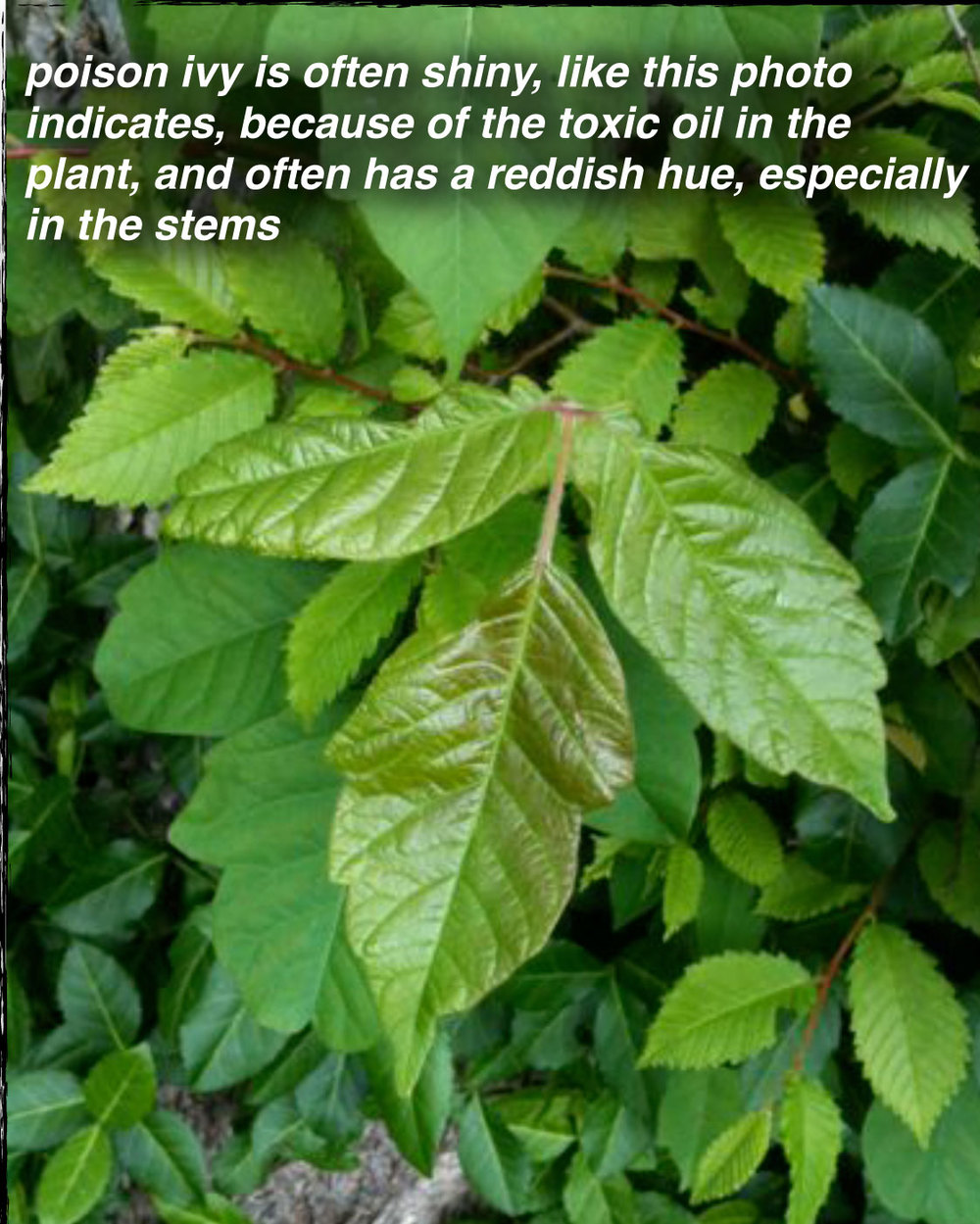
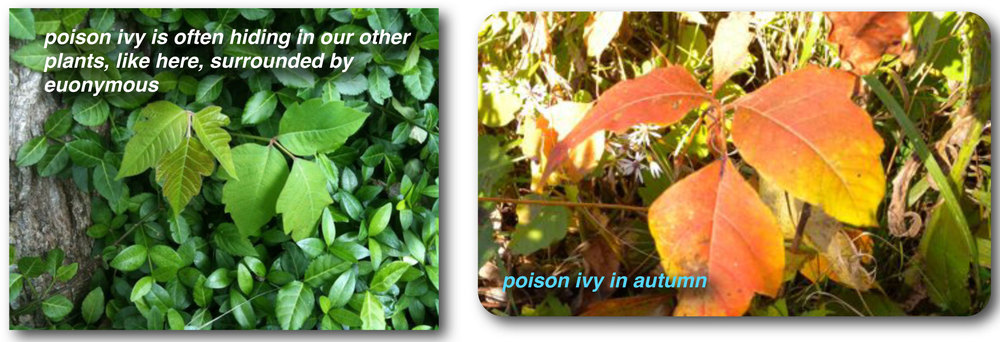
This season finds many of us out in our gardens or in local forest preserves, with fall color not far away. Since we spend a good deal of time in your yards, as well, we know that there is a lot of poison ivy out there, even more with all the rain we have had. As professionals, we realize that the best way to avoid this often agonizing malady is to be able to identify and stay clear of the plant.
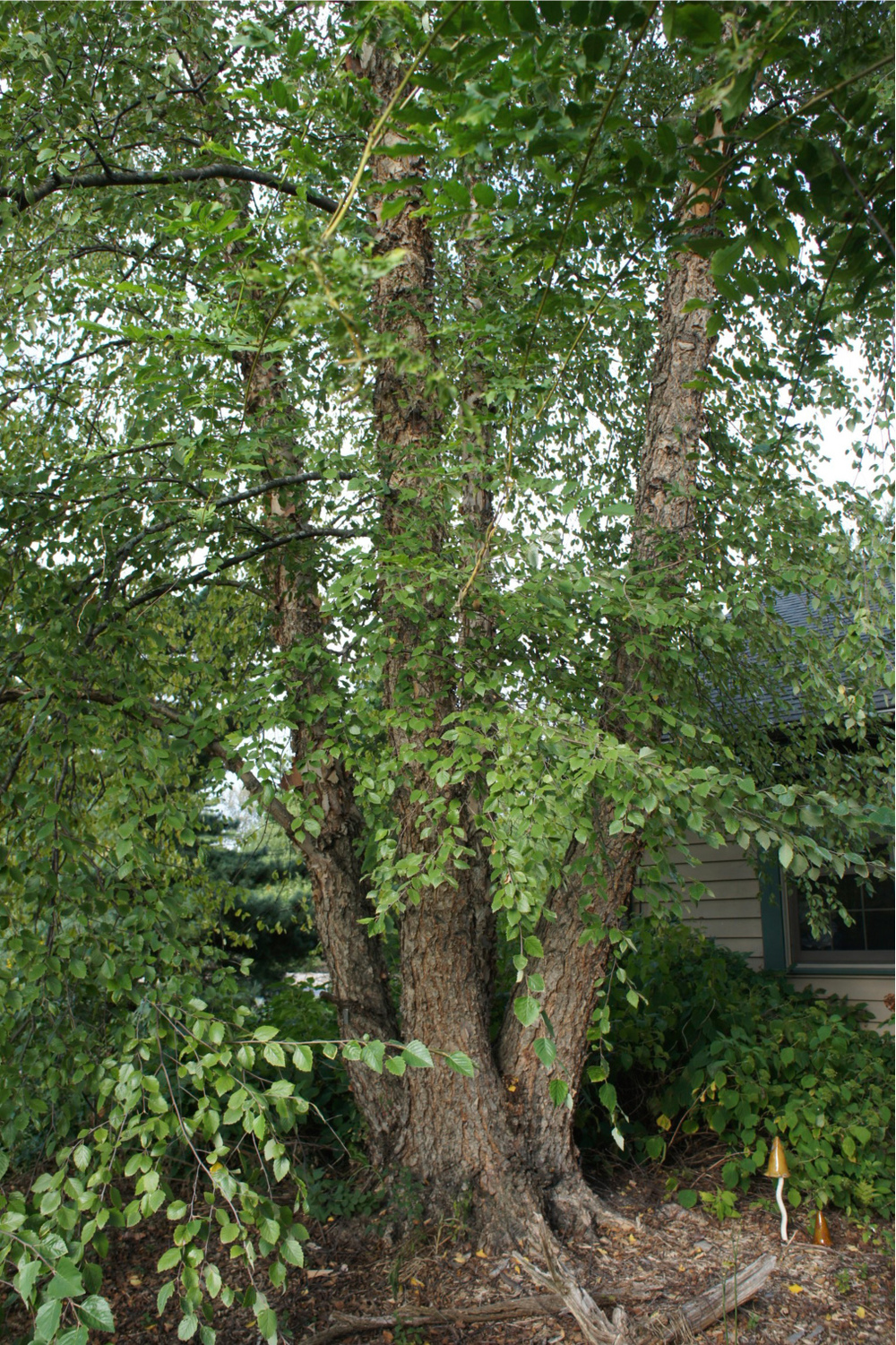
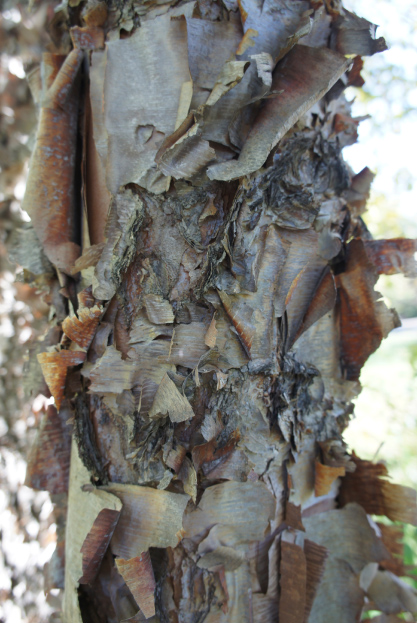
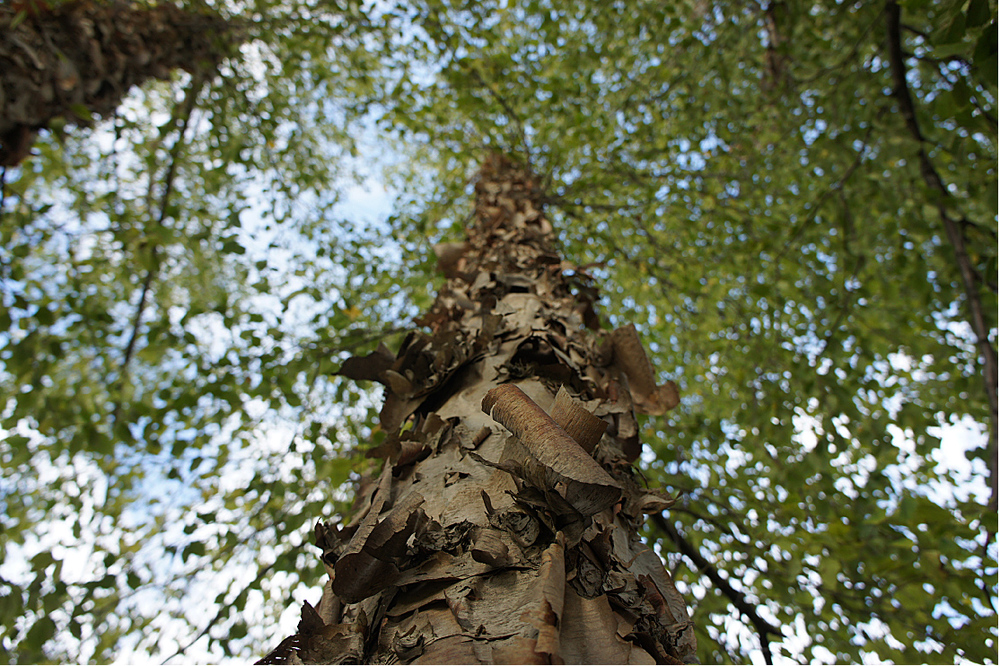
River Birch by Lesley Bruce SmithThe River Birch is one of the few Birch species that are actually native to the warmer climates of the southern tip of Lake Michigan. We love it for its amazing creamy cinnamon colored bark which adds so much winter interest in the leafless seasons of the year. We like to plant these trees in clumps and so they are propegated this way in our nurseries. A five trunked birch tree is actually 5 different trees that were gathered together as infants and forced to grow as a unit.
Birch trees were considered sacred by the aboriginal peoples of North America and the Chippewa peoples were very clever in the use of it’s bark, creating cups, bowls, kettles, serving dishes, coffins, wigwams, sleds, dolls and many other important items for daily use. Birch trees were even used for setting broken bones. Birch trees prefer a more acidic and well drained soil and so they often suffer from chlorosis or yellowing of the leaves, due to the unavailability of nutrients which are tied up in our alkaline clay soils. We also often plant them next to our homes, adding to this problem, because construction disturbed, concrete filled soils are extremely alkaline causing all kinds of problems for our friends the birch trees. It helps to offset these problems by keeping these trees mulched out to the branch spread in an attempt to return their surrounding soils to a more acidic environment.
Biochemicals from the birch are found in almost every home of the Western world in the form of aspirin. Over 100 BILLION aspirin pills are consumed annually around the world. So the next time you take two, you can thank a birch tree.
Fall Colors
Backyard Wisdom by Gilbert A Smith ISA Master Arborist
A description of how fall color appears by master arborist Gilbert A Smith and cert. Arborist Lesley Bruce Smith of Arborsmith, craftsmen in the care of trees and shrubs. This video explains what triggers fall color and what creates the showy displays in an easy to understand way.
Poison Ivy
Mother Nature's Moment by Lesley Bruce Smith ISA Certified Arborist
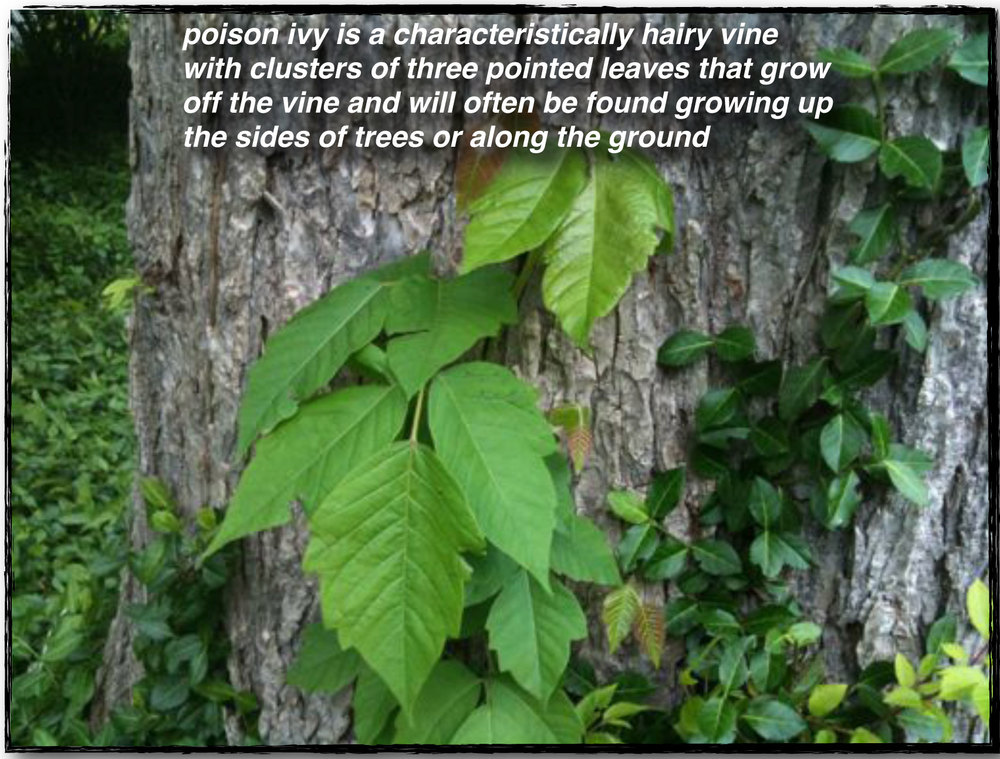
This season finds many of us out in our gardens or in local forest preserves enjoying fall color. Since we spend a good deal of time in your yards, as well, we know that there is a lot of poison ivy out there. As professionals, we realize that the best way to avoid this often agonizing malady is to be able to identify and stay clear of the plant.
You may not know that humans react to the oils in poison ivy (Toxicodendron radicans) and that our contact with it does not have to be direct. If our pets walk through it and we touch them or we walk through it and then touch our shoes or touch any thing that has been in contact with it, the oil can rub off and cause a reaction. What we have also learned, from painful experience and from our doctor, is that our skin cells actually have a memory and when we are exposed to poison ivy over long periods our reactions become more intense. When we get a particularly bad case, it becomes somewhat systemic and can pop up as big blistered sores on other places of our body....yuk!
The good news is that when you know how to identify and stay clear of poison ivy you can stay rash free. Our sons, avid outdoorsmen, who are now in their 20’s and who learned to identify poison ivy as very small children have never had a case of it because their exposure has been so limited.
Avoid the painful experiences of poison ivy exposure by eliminating it in your yards and gardens by cutting vines and using Glyphosate (generic original Round-Up) weed killer, carefully following manufacturer’s labeling. Whenever working around poison ivy cover your exposed skin by wearing long pants and long sleeve shirts and be careful to remove and wash them immediately using hot water and good laundry soap. Then bathe using laundry detergent or Fels Naptha soap thoroughly cleansing your skin, both areas that were exposed or unexposed. The oil can remain viable on your tools, gloves, shoes and clothes for days afterward! When you know what poison ivy looks like you can stay away from it on the trails and forest preserves and in your own back yard.
If you know your skin has been in contact with poison ivy you can greatly lessen or completely avoid a rash by washing the affected area using laundry detergent within 1/2 hour of exposure. The laundry soap or Fels Naptha soap are the only soaps we know of that have significant surfactants to disperse the oil of poison ivy. Caution: hand or dish soap will make it worse!
Poison Ivy by Lesley Bruce Smith
Arborsmith, Ltd.® crafstman in the care of trees
Gilbert and Lesley Smith are ISA Certified Arborists, have university degrees, and have been caring for trees on Chicago's North Shore since 1980. Arborsmith. LTD., Lake Bluff IL | (847) 634-7734.
Proper tree preservation and maintenance can only be done by those who have advanced technical education in the art and science of arboriculture. Arborsmith. LTD has the hands of experience to care for your trees from the roots to the crown—from their planting to long term care. Arborsmith is able to deliver a level of care that is beyond the typical certified arborist. We have a passion for stewardship, to help you protect your corner of the earth.
Backyard Wisdom - March/April 2022 by: Gilbert A Smith, ISA Board Certified Master Arborist
I’m sorry to say it, but we had to take this tree down for safety reasons. But, it has a story to tell us, from the inside out!
This Norway Maple landed as a “whirly bird” seed on a bluff overlooking Lake Michigan in Lake Forest in 1960. I counted the annual rings as best I could. I guess everyone knows how to count the tree rings to determine the age of a tree. In April 2019 in our Wisdom From The Trees article Lesley and I talked about how trees grow and how they heal. Also Aldo Leopold, in his famous book, The Sand County Almanac explained the history in the rings of a tree.
Mother Nature’s Moment - March/April 2022 by: Lesley Bruce Smith, ISA Certified Arborist
This week, like many times in the spring of the year, I was asked to visit a client property to examine some large Arborvitae to see why they were not doing well. The client thought that she needed a price for fertilizing these “stressed trees”.
It has been a rainy week after many months of drought in the Chicago area. As I stepped into the back yard I noticed I was stepping onto completely sodden soil. My shoes were making sucking noises while walking the length of the lawn to the back property line where the big Arborvitae were planted. It was easy to see from a distance that the area around the trees was about an inch or two under water. I managed to get under the trees and check out the soil with my soil probe. No surprise that the heavily clay like soil was totally saturated to about a foot below the surface.
Backyard Wisdom - January/February 2022 by: Gilbert A Smith, ISA Board Certified Master Arborist
Driving through Deerfield a few months ago I stopped to take a picture of the above (left) pictured declining Norway Spruce. Almost every day we get asked, “What is killing my trees and what can you spray on them to save them?” When I drove up to these sick trees my thoughts were similar. Is this being caused by a disease or by a bug?
Mother Nature’s Moment - January/February 2022 by: Lesley Bruce Smith, ISA Certified Arborist
It has been a while since we have published our newsletter and I thought since we have undergone some staff changes it would be a good time to make some introductions.
Backyard Wisdom - June/July 2021 by: Gilbert A Smith, ISA Board Certified Master Arborist
I got a call from a client this spring (2021) asking me to check her Beech tree this summer and spray any caterpillars that might kill it. This Beech is her favorite tree. I told her that I would do that and not to worry because caterpillars on Beech trees are normal, natural and healthy. She replied with enthusiasm, “Don’t tell me that! I don’t want my tree to die!”
Mother Nature’s Moment - July 2021 by: Lesley Bruce Smith, ISA Certified Arborist
It has been a “good” year for funky leaf galls, or a bad year, I guess, depending on how you look at it. Galls are “abnormal vegetable growths caused by various agents, such as, insects, nematodes, fungi, bacteria, viruses, chemicals and or mechanical injury”. When our clients ask about these funny bumps on their tree leaves, I usually stop at the short explanation that they are completely harmless to the tree and normally caused by beneficial insects that lay their eggs in the leaf tissue which causes the strange growth they are seeing.
Backyard Wisdom - May 2021 by: Gilbert A Smith, ISA Board Certified Master Arborist
This White Oak branch has been hanging in there for about 80 years so we can assume that it is pretty strong. Growing in Old School Forest Preserve in Lake County, IL, this tree is in its natural state, but what if it was growing in your landscape? Would you worry about this branch falling? Many homeowners worry, and for what seems like good reason; this branch is low, long and heavy. We wonder, how can it possibly not break? Because of that, in many landscapes, all of the beautiful low branches on our trees are cut off.
Mother Nature’s Moment - May 2021 by: Lesley Bruce Smith, ISA Certified Arborist
These last two years we have all learned about our deep needs as humans to be together. We were not meant to live in isolation, to spend long hours, days, months with very little meaningful interaction with others. Going about our days behind masks, unable to even read the cues that all of us take for granted in our unspoken communications with one another. We have been diminished by all of this and knowingly or unknowingly are in grief around all we have lost.
Backyard Wisdom - February | March 2021 by: Gilbert A Smith, ISA Board Certified Master Arborist
With snow on the landscape and temperatures in the cold range you're probably not thinking about trimming your deciduous (non-evergreen) shrubs. Still, now and until the leaves come back in May/June is a really great time to trim them. I’m going to give you easy to follow, step by step directions.
Mother Nature’s Moment - February | March 2021 by: Lesley Bruce Smith, ISA Certified Arborist
Almost every month we come to you with new information about trees. This month, and on and off in the months to come, I am going to try to introduce you to some of our good friends in the tree family.
The best way to learn the names of trees is to “get to know them”. The same way you get to know a new friend. First you learn their names, then you can remember their name when you see them and recognize their face and hair and the color of their eyes. Then, as you get to know them really well, you can tell what they look like from a long distance away, because of the way they walk or talk or have unique expressions or characteristics. It all becomes very familiar to you. You even learn to recognize them no matter what they are wearing or if they have had a hair cut. You KNOW them!
“What is the matter with my Boxwood?” Lesley and I have been asked this question much too often in the last few years. Boxwood (Buxus sempervrens, microphylla, etc.) have many troubles, for example: Leaf Minors, Leaf Curlers, Spider Mites, Psyllid, Volutella and Phytophora fungal blights, Nematodes, too much water on overhead sprinklers, or too little water, winter damage, frozen soils, heavy soils, Boxwood Decline and most recently, Boxwood Blight. None of these by themselves are the cause of most of the Boxwood dieback. We can go through all kinds of soil and tissue samples, fertilizers, fungicide and insecticide sprays and still be missing the main cause.
Mother Nature’s Moment - January 2021 by: Lesley Bruce Smith, ISA Certified Arborist
A decade ago when we were first visiting our daughter’s-in-law family home in the mountains of Austria we had the privilege of witnessing life on a European farm first hand. While there we watched her young cousins on the mountain alm1 playing, half naked in the pond where the pigs were bathing too. It was one of the first of many real life lessons, since, on the value of biodiversity, and the role of microbes in developing our human immune systems.
Backyard Wisdom - December 2020 by: Gilbert A Smith, ISA Board Certified Master Arborist
Most of us have had a lot more time to be observing our own back yard this year. In your wanderings have you noticed little 1/2 inch mounds of soil often with pencil sized holes right in the center? What you’re looking at is the work of 250,000 native earth worms as they farm your back yard soil. What are they doing? They’re coming up to the surface, grabbing leaves, pulling them into their burrows and eating them.
Mother Nature’s Moment - December 2020 by: Lesley Bruce Smith, ISA Certified Arborist
Thirty years ago when our sons were in grade school they had a classmate that had to flee, with his mom, out west to a place above tree line in order to not suffer horrendous neurological symptoms due to the abundant use of toxic herbicides and pesticides in our suburban landscapes. This was not a very sustainable situation.
Backyard Wisdom - November, 2020 by: Gilbert A Smith, ISA Board Certified Master Arborist
I didn't rake any leaves in my landscape this fall. I never rake leaves. That’s not because I have someone else do it, nor is it because I’m lazy, (though that point can be debated). It’s because leaf raking is a waste of my time and a waste of the fuel that powers our back yard ecosystem.
Mother Nature’s Moment - November 2020 by: Lesley Bruce Smith, ISA Certified Arborist
This time of year the question of “How can we tell what is alive or dead?” is a frequent one. It is so second nature to us that we often forget to explain to you how we tell if a branch is alive or dead in the middle of the “dormant” season. Let’s start by talking about what we mean when we say: “dormant season”. In the ‘olden days’, our understanding of what deciduous trees were doing in the winter was intuitive but inaccurate. Trees that lose their leaves in the autumn, do slow down their processes in order to survive the long journey around the sun. However, to say that trees go dormant during the winter is a bit misleading.
Backyard Wisdom - September 2020 by: Gilbert A Smith, ISA Board Certified Arborist
Forty-five years ago in Agronomy class I wondered what was so important about soil structure? Those of us in the plant world know that soil is made up of various ratios of sand, silt, clay and organic matter. We can test it for plant essential minerals like, nitrogen, phosphorus, potassium, etc. But what exactly is soil structure and why is it so important?
Mother Nature’s Moment - September 2020 by: Lesley Bruce Smith, ISA Certified Arborist
Dr Alex Shigo, the father of modern arboriculture, once said: “Trimming your trees is one of the best things you can do for them, if you do it properly, and one of the worst things you can do, if you do it improperly.”
For a multitude of reasons we are seeing a huge number of trees that have been over trimmed or trimmed improperly. So what does that mean or what does it look like?
Summer 2020 - Backyard Wisdom by Gilbert A Smith, ISA Board Certified Master Arborist
Right now, in our forest preserves and our landscapes we see the evidence of too much water causing our trees to die from drought. Let me explain. Trees, like every organism, need to breathe. Of course, we all know that during the day tree leaves use CO2 and give off O2, through the miracle of photosynthesis. What we may not realize is that trees, like us, respire all the time using O2 and giving off CO2. They don't have mouth parts, but they do have openings called stomates in their leaves, lenticels and ray cells in their stems and roots through which they ”breathe”.
Summer 2020 Mother Nature’s Moment by: Lesley Bruce Smith, ISA Certified Arborist
It seems very counter intuitive that browning and dead leaves could be caused by too much water, but I wish I knew how many times in the last several weeks I have had to say to clients…”This is a problem that has been caused, or made worse, by cool, very wet spring weather.”
by: Board Certified Master Arborist, Gilbert A Smith Backyard Wisdom - April/May 2020
Fifty years ago when I was a young “tree skinner” Yes, that’s what they called us and with good reason. I was taught to paint all of the cuts that I made with tree tar. That was the measure of a good job. My father would say, “I saw a lot of ‘white eyes’ in the trees you trimmed today.” What an insult! “White eyes” were the newly exposed round tree cuts that looked like eyes on the branches.
by: ISA Certified Arborist, Lesley Bruce Smith Mother Nature’s Moment - April/May 2020
This last winter when attending the iLandscape conference we listened to a seminar entitled Healthy Hedges. It essentially was teaching how to eradicate weedy species from established hedges in the landscape. This is not a new subject to us so I was surprised at the insights I gained. I have never been accused of being a fan of European Buckthorn, ever. I have always said the only good Buckthorn is a dead Buckthorn.
by: Gilbert A Smith, ISA Board Certified Master Arborist Wisdom From the Trees - February/March 2020 - Backyard Wisdom
So why does all this dirty talk matter?
Everyone who loves the natural world is concerned with global warming and its unpredictable effect on our’s and our children's lives. But it often seems as if it is out of our hands as individuals. It turns out, however, that carbon is the currency of the underworld, even in our own backyard. Let me explain.
by: Lesley Bruce Smith, ISA Certified Arborist, Cancer Survivor Wisdom from the Trees - February/March 2020 - Mother Nature’s Moment
These are indeed strange times. We feel it is vitally important to keep on the “sunny side” if you will, as we face down uncertainty. With that top of mind we are reminded that our lives, our health and our safety depends in large measure on our continued care for ourselves and the planet we live on.
by: Gilbert A Smith, ISA Board Certified Master Arborist Backyard Wisdom - January 2020
How do roots grow through the soil? How do they know where the life essential water and minerals are located and how do they “eat and drink” them? In January 2019 I wrote in Wisdom from the TreesTM about the leaves’ long journey into the soil. Today, I want to take you further on that journey into the underground world of tree roots.
by: Lesley Bruce Smith, ISA Certified Arborist Mother Nature’s Moment - January 2020
In these colder, dark shorter days of winter I am reminded that we are indeed “beings of light”. This is a phrase that is tossed about somewhat lightly in our culture. As a horticulturist whose job it is to save trees, let me shed a little light on light (no pardon for all the redundancy).
Backyard Wisdom - November 2019 by: Gilbert A Smith, ISA Board Certified Master Arborist
Everyone knows that deciduous trees go dormant and shed their leaves so that they don't freeze in the cold winter. So why don't evergreens shed their needles too? Actually, they do loose their older needles continuously throughout the year, as the older needles are shaded out by younger ones. This may happen most heavily in the fall, as is demonstrated every autumn, by our clients who begin to call, worrying about brown needles on their evergreens. The good news is, they never lose all of their needles, unless they’re dead. Evergreens are green throughout the year, but they don’t have the same needles forever!
Mother Nature’s Moment - November 2019 by: Lesley Bruce Smith, ISA Certified Arborist
The vast majority of our tree friends in the northern hemisphere do a great job of preparing for their winter journey. They don’t leave home, so their journey through time demands careful preparation for the freezing cold and weighty snows they will encounter during the winter. This year, those freezing temperatures arrived faster than normal. However, the native Illinois trees, early snows or not, go through the same cell hardening as during a balmy autumn. Thanks to a plant pigment called phytochrome, the cells that need to “harden” take their cues from the always faithful shortening of days, not our uncertain temperatures.
Arborsmith, Ltd. is proud to announce that Gilbert and Lesley Smith have been awarded the True Professionals of Arboriculture 2019 Award by the International Society of Arboriculture (ISA). Recipients are awarded for excellence in advancing the profession of arboriculture through education, communication, and public outreach.
Many many thanks to all of you who so graciously responded to our news regarding the ISA True Professionals Award. We so appreciated your words of encouragement and congratulations. We are sharing here the 90 second ISA video that was created for us when we received the award in Tennessee in August, so you could all share in this celebratory event with us. You are the ones who helped make this all happen, because we didn't do this alone. Regards, Lesley and Gil
by: Gilbert A Smith, ISA BC Master Arborist Backyard Wisdom September 2019
Years down the road from the time your landscape was originally planted, Arborsmith Ltd. is called in to diagnose tree problems. Why is my River Birch doing so poorly when my neighbor’s is healthy? It is hard to answer that question without going back to the original construction. Most of our tree problems begin and end with the soil. We can’t see under the ground. We can test the soil and sample the leaves but all we have to do is move 10 feet away and the soil conditions change. Let me tell you the story of a typical suburban soil and how it affects tree health.