
Wisdom from the Trees articles
Tree of the Month

Tree of the Month May/June 2018
by: Lesley Bruce Smith, ISA Certified Arborist
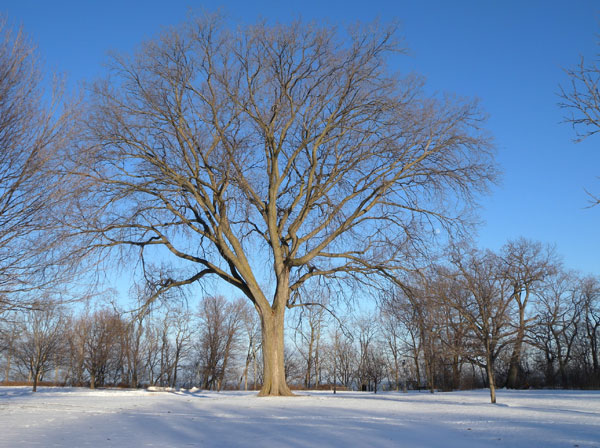
When I was a little girl, like many who grew up in communities east of the Mississippi River, I lived on a street lined with American Elms. Although it is against every piece of advise we now share, to line streets with the exact same species, I can’t help but think back in wonder at those amazing cathedral like arches that lined so many American City streets in the last century. It is a memory held by so many of us over the age of 50 that it is little wonder that so much hybridizing has been done with the American Elm.

Tree of the Month October/November 2017
by: Lesley Bruce Smith, ISA Certified Arborist
Baldcypress, contrary to what most Chicagoans realize, is a native Illinois tree. Although it is found naturally growing more readily in the southern parts of our state it can survive and thrive in the Chicago area. It loves wet boggy like soil conditions and its wood is wonderfully resistant to both rot and insects.
Probably one of the most distinctive characteristics of this beautiful and majestic tree is the fact that it is a needle bearing, cone producing deciduous tree that drops its leaves in the fall after a brilliant show of autumn color. Another unusual identification feature is its propensity to grow “knees” under its branch spread sticking up out of the ground looking much like supporting buttresses.

August/September 2017 Tree of the Month
photos and text by: Lesley Bruce Smith
The unusual leaves of the Ginkgo tree are both lovely and familiar due to it’s many unique traits. It’s leaves are unlike those of any other existing tree, although fossil records are plentiful of this ancient tree, which even predates the conifers, of which they share many important characteristics. The Ginkgo biloba is also known as the Maidenhair Tree because its leaves are similar in shape to the fronds of the maidenhair fern.

Burr Oak Quercus macrocarpa
by: Gilbert A Smith, ISA Certified Master Arborist
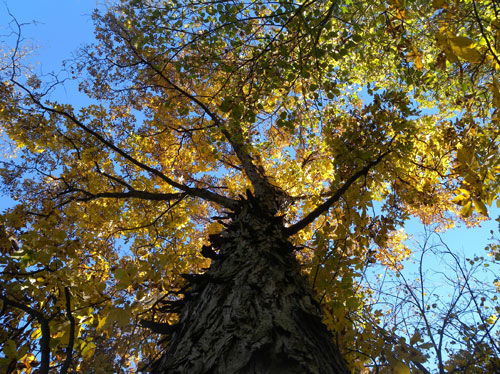
The Burr Oak, or Quercus macrocarpa, is one of our absolute favorite trees. It’s magnificent stature is a real stand out in the native Illinois prairie. It has a really thick, sometimes several inches, tough craggy bark that just can’t be mistaken for any other species and that same bark makes it able to survive the prairie fires that raged across the Illinois plains in earlier days.

Prunus serotina | Also called Wild Cherry or Rum Cherry
by: Gilbert A Smith, ISA Certified Master Arborist
A large shade tree in our area of 60 feet tall, Black Cherry can grow to 100 feet where its “feet” are not standing in our heavy, clay, Illinois soil. Actually almost every tree species except Willow and Cottonwood grow 30% taller east of Lake Michigan due to the well drained, loose soil that accommodates tree roots so much better than prairie soil.

Tree of the Month - April 2017
by: ISA Certified Arborist Master Arborist, Gilbert A Smith and Certified Arborist, Lesley Bruce Smith
Right now every plant feels like it is flowering and the trees are at full flower strength too, Spring frolicking isn’t just for the birds and the bees. Much of that chartreuse green we see on the trees all over is not the expected new green leaves, so much as the tree flowers. There are, of course, the beautiful showy flowers of the Magnolias, Crabs, Redbuds, and Callery Pears that we love. But the less showy flowers that are bright green and sometimes less vibrant hues of pink or yellow are also in abundance this time of year.

Tree of the Month - March 2017
by Gilbert A Smith, ISA Certified Master Arborist
I’m speaking with one of the oldest and wisest residents of Lake County Illinois. She lives in Deerfield beside the play ground on Carlisle Avenue and has stood in that place for more than 200 years. The trail marker tree was a sapling in the late 1700’s when she was selected to be a guide for the Potawatomi Indians.
Gil: I’ve been coming here to visit you for more than 30years and you never seem to change. Why are you still here when most of the other trees in the area are less than half your age?

September 2016 Tree of the Month and Backyard Wisdom (combined)
Willow name
by: Gilbert A Smith, ISA certified Master Arborist
Mrs. Willow lives in the Chicago Botanic Gardens, dipping her roots into the waters of the Great Basin.
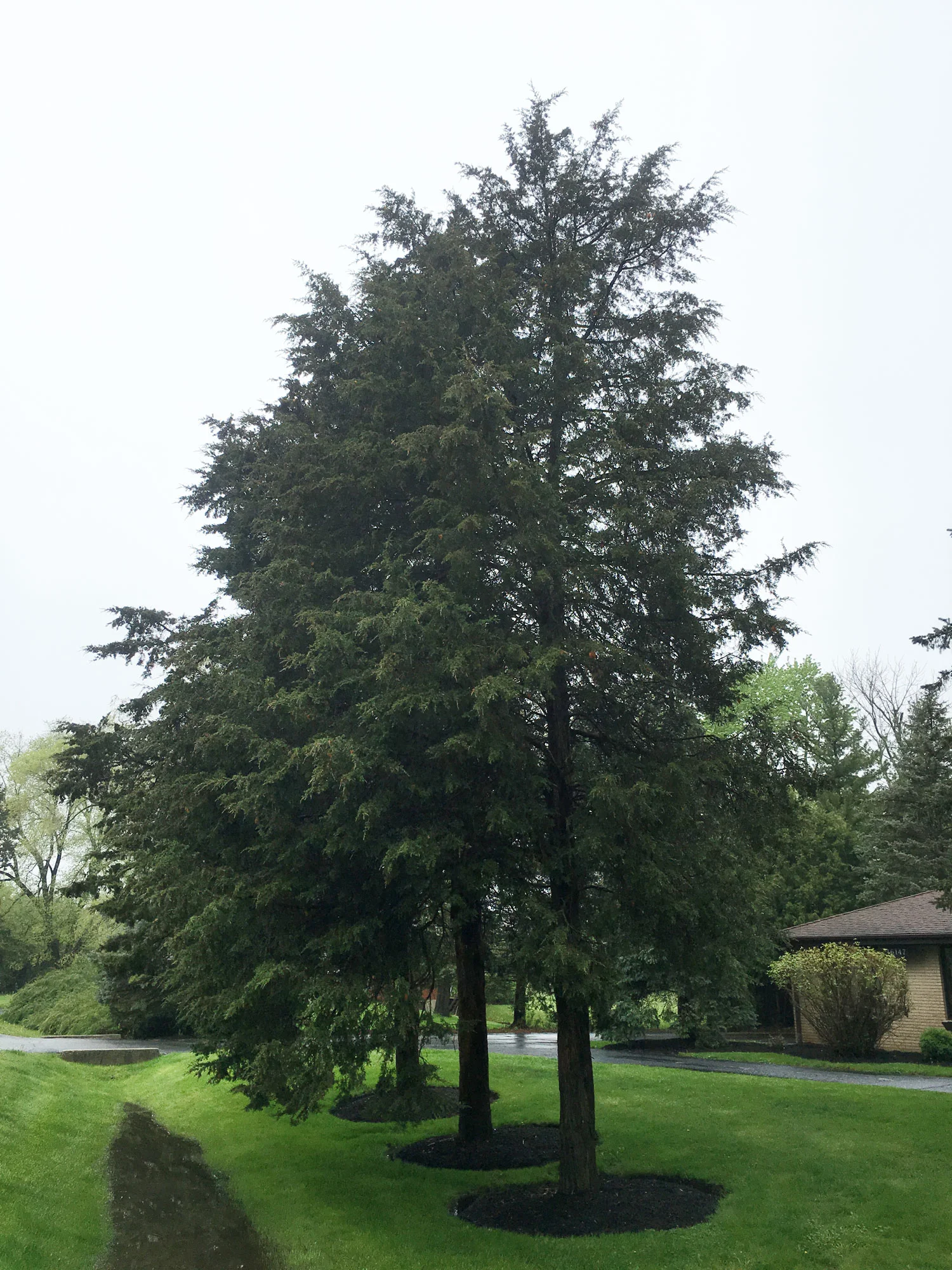
Eastern Redcedar • Juniperus chinensis
by: Gilbert A Smith, ISA certified Master Arborist
You may remember me saying in the past that there were no native evergreens in Northeast Illinois when European settlers arrived. If there were a native evergreen it would be the Redcedar. It’s really not a Cedar, it is a Juniper but it looked like a European Cedar tree in the 1500’s when explorers first named it. It’s also not a native. An inhabitant of the toughest places in the eastern forest it can’t stand prairie fires set by Mother Nature or the Native Americans. As soon as farmers plowed the prairie and suppressed fires, the Redcedar headed West of Lake Michigan.

American Hop Hornbeam, Ironwood, Leverwood
Ostrya virginiana
by: Gilbert A Smith ISA Board Certified Master Arborist
Ironwood is one of my favorite trees because it is a native understory in the forests all around us. It has been here longer than most of our common street trees like Honeylocust, Norway Maple or Magnolia yet no one knows it. It is a nice small tree, (30 feet by 20 feet) and unlike most trees it is shade tolerant which makes it desirable in a mature landscape. Its bark and leaves look deceptively like American Elm so it blends in and you may not even know you're looking at it.
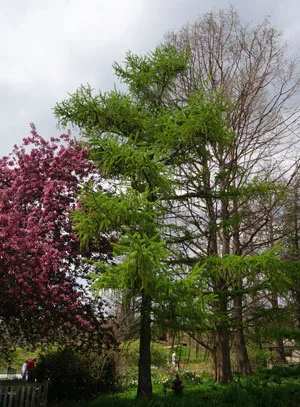
Larch or Tamarack • Larix laricina
by: Gilbert A Smith, ISA certified Master Arborist
The scrappy Larch Tree has lived in Illinois since the glaciers retreated 6000 years ago. Like a living museum a small remnant of plants survive in Volo Bog about 40 miles NW of Chicago. You’ll find the Larch trees on an island of peaty soil floating on the surface of the bog. If you're there on a stormy day you can actually feel the whole land mass move or “quake” because it’s floating.
January 2016 Tree of the Month and Backyard Wisdom (combined)
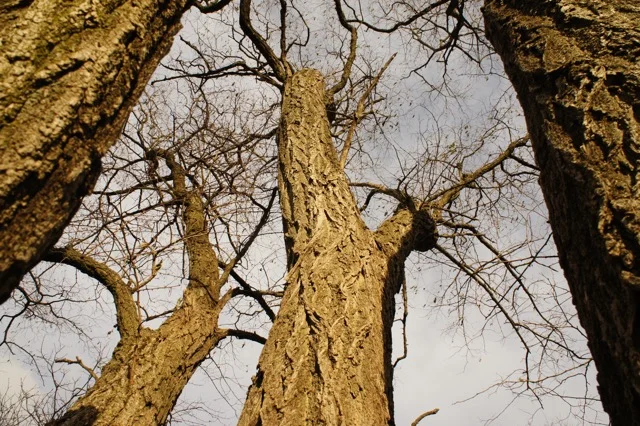
Black Locust Robinia pseudoaccacia
by: Gilbert A Smith, ISA certified Master Arborist
In the early 1900’s unscrupulous land speculators sold property in the great plains claiming buyers could “strike it rich” farming the vast grasslands. Originally plains looked green and promising in Texas, Oklahoma, New Mexico, Nebraska, and Kansas because although the annual rainfall was only 10 inches the prairie grasses were well adapted. Like all grasses, when the rain stops, they simply go dormant and when the drought ends they green up. (Note, this is the same today with our lawn grasses so we really do not need to water as much as we do.) The native grasses were tough and the thick roots that were so hard to till, held the soil in place. The modern sod busting plow and tractor, they thought, were just the tools to exploit this treasure. Hundreds of thousands headed west to make their fortune.
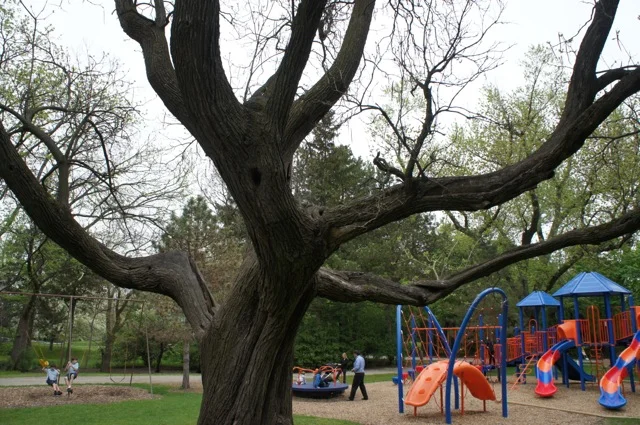
Tree of the Month - Catalpa • Catalpa speciosa
October/November 2016
by: Gilbert A Smith, ISA Master Arborist
In the Park in Glenview where I grew up, my father grew up and my grandfather raised his family stands an ancient weatherworn Catalpa tree. The leaves are giant “elephant ears” that sway in the slightest breeze.
The huge Pinky-white flowers cover this 60 foot tree even at the top in May/ June. It is one of the few large shade trees with showy, sweet smelling flowers.
The long, thin, cylindrical, fruit pods hanging down within reach can be popped into a child’s mouth as a pretend cigar. That’s where this tree gets one of its common names, Indian Cigar Tree.
Tree of the Month
Silver Maple, Acer saccharinum
by Lesley Bruce Smith, ISA Certified Arborist
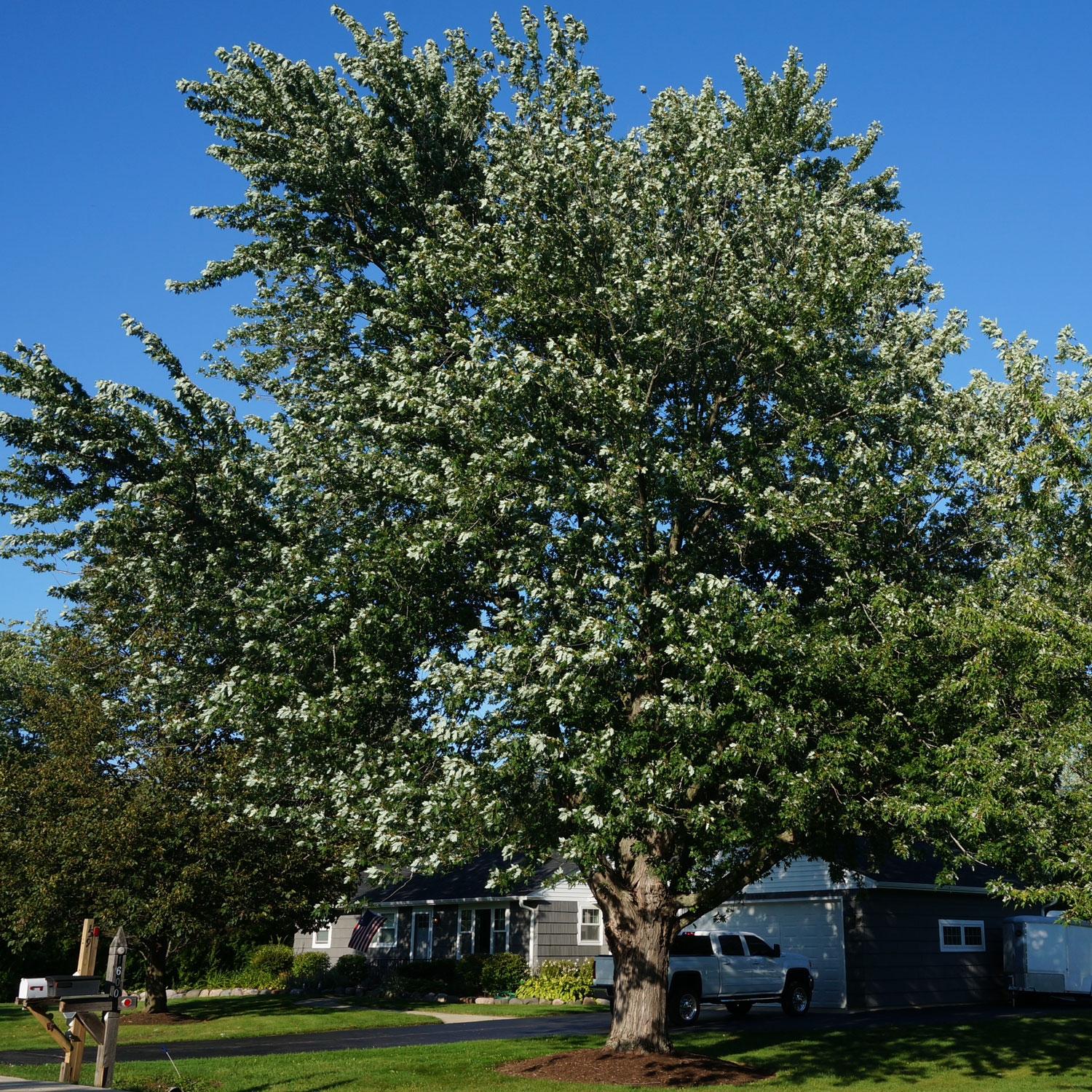
The Silver Maple is one of those trees that gets a lot of bad press. It is not one of our favorites because it has a history of poor structure and due to it’s fast growth habit is considered to be a weak tree. But like any tree planted in the right location and given the necessary growth requirements it has much to commend it. Personally, I love the view of a big Silver Maple on a windy day. That’s when we can see and appreciate the lovely silver greygreen undersides of the leaves contrasted against the dark green on the topsides. I’ve lived across the street from one for over two decades.
Tree of the Month
Eastern Cottonwood • Polulus deltoides
A tree memory submitted by Nancy Anderson, Interior Designer, a gifted and creative designer, and a kindred spirit. nancyandersondesign@comcast.net
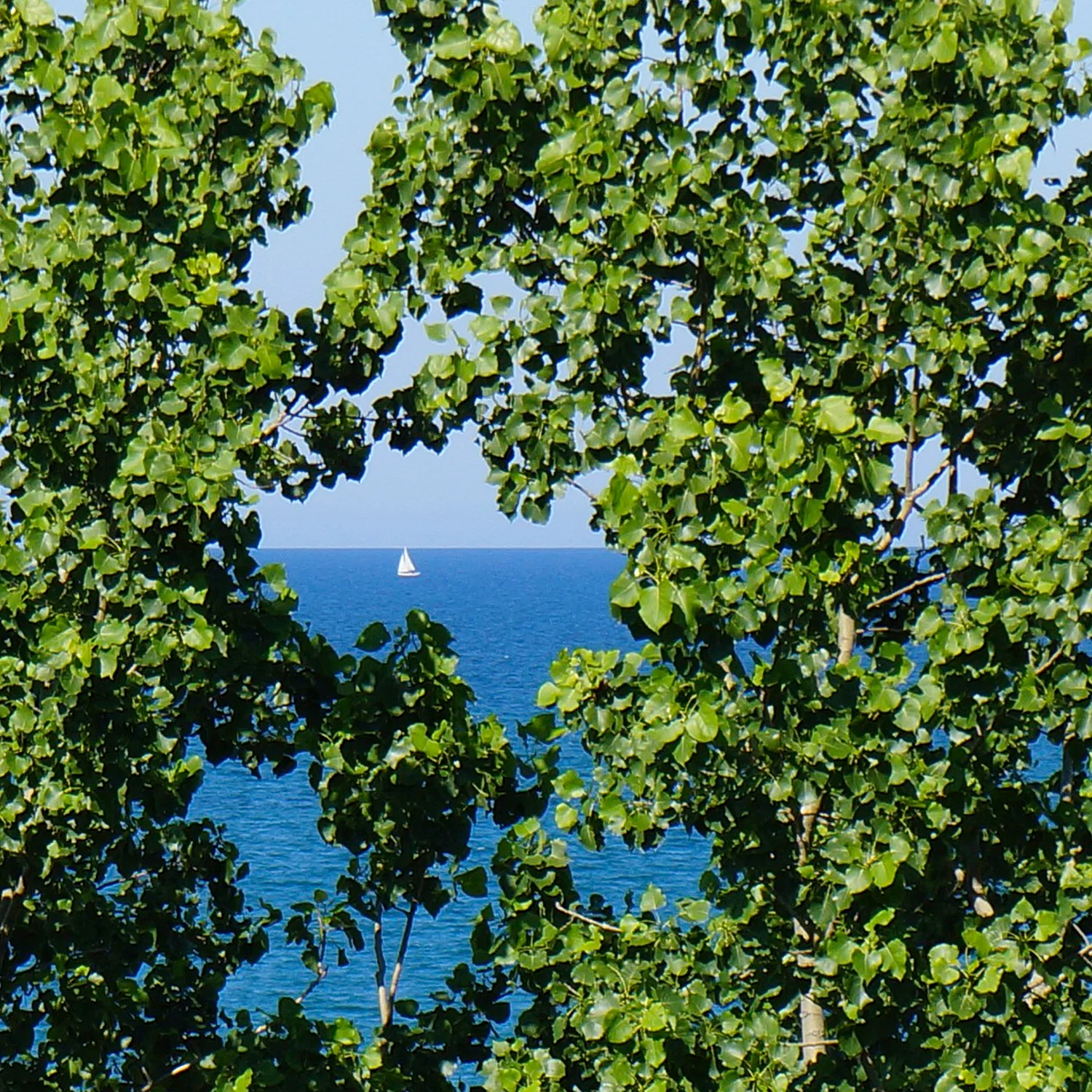
Behind our backyard, a few feet out into the nature preserve, stands a 60’ Cottonwood tree. Yes, I know that Cottonwoods are kind of considered big weeds, have soft wood, and make a mess. But this one is particularly dear to me. For the 20 years that we've lived here, we've seen it grow from a little twig into a large fine tree that provides shade, perches for more kinds of birds that I can count, and most of all, holds wonderful memories.
Lesley takes a licking and keeps on ticking
On May 18th Gil and I went out for a bike ride. At the end of our street I had a really serious accident that sent me catapulting over my handlebars and landing 12 ft away on a concrete sidewalk. The result was a broken left arm and a bruised, displaced and extremely painful right clavicle. Thankfully I was wearing my helmet, which I always do, or I probably wouldn't be able to write this. All this to tell you that it has slowed me down a bit. The remaining staff stand at the ready to serve you and I will be back in the quick as soon as I can!! - Lesley
Tree of the Month
Mulberry • Morus alba
A memory shared my Mike Kaniok, a compassionate and caring financial planner with Edward Jones • mike.kaniok@edwardjones.com
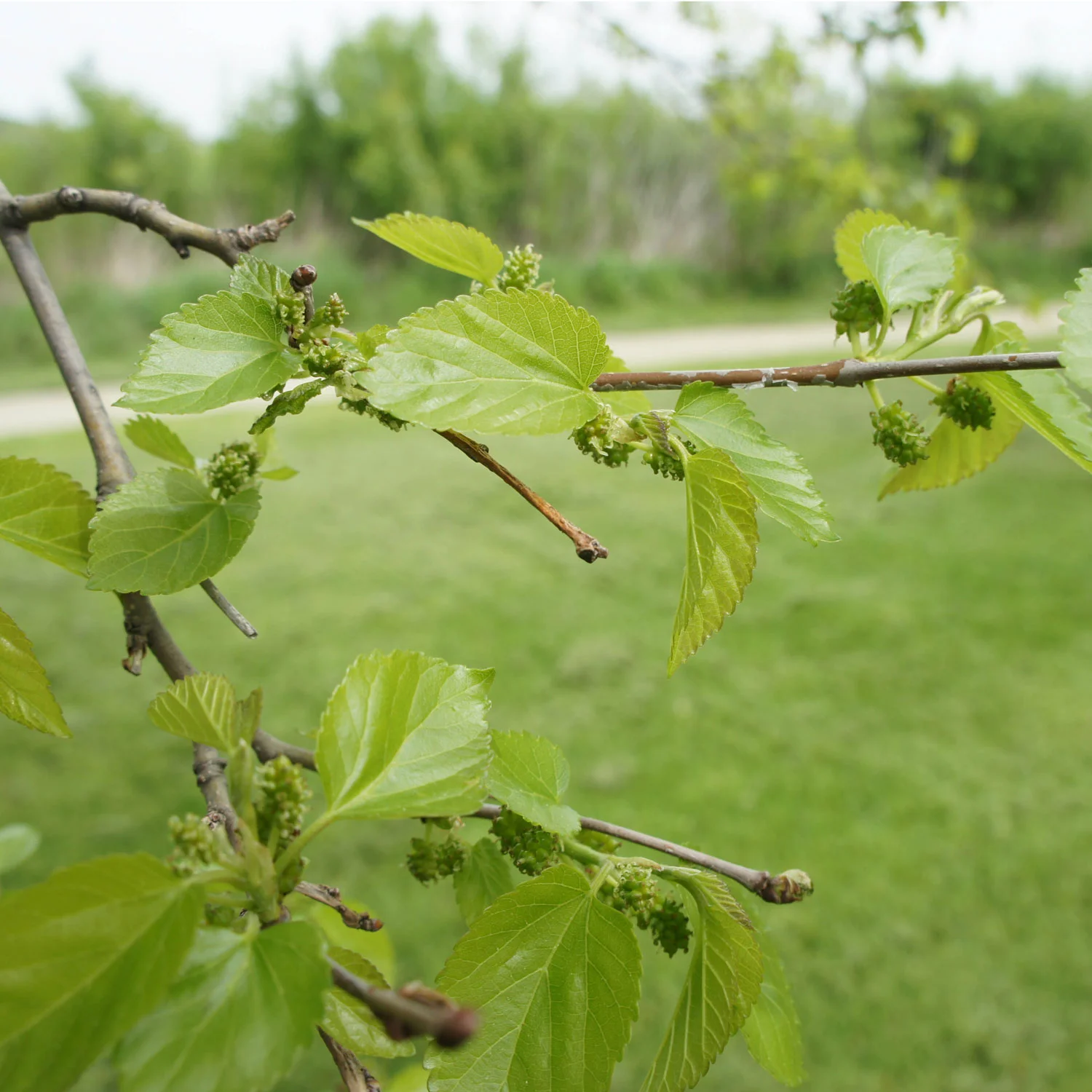
When I was a little kid, all the way up to about 13 years of age, we lived across the street from my grandparents' house. In their back yard was a large Mulberry tree.
I loved that tree. We spent all summer every year climbing that tree. We would eat mulberries until we were sick. My grandmother would place a large sheet under the tree and we would shake the branches so mulberries would fall and she could use them to bake us a pie.
Crabapple, malus
by: Lesley Bruce Smith, ISA Certified Arborist
Photos by Lesley Bruce Smith
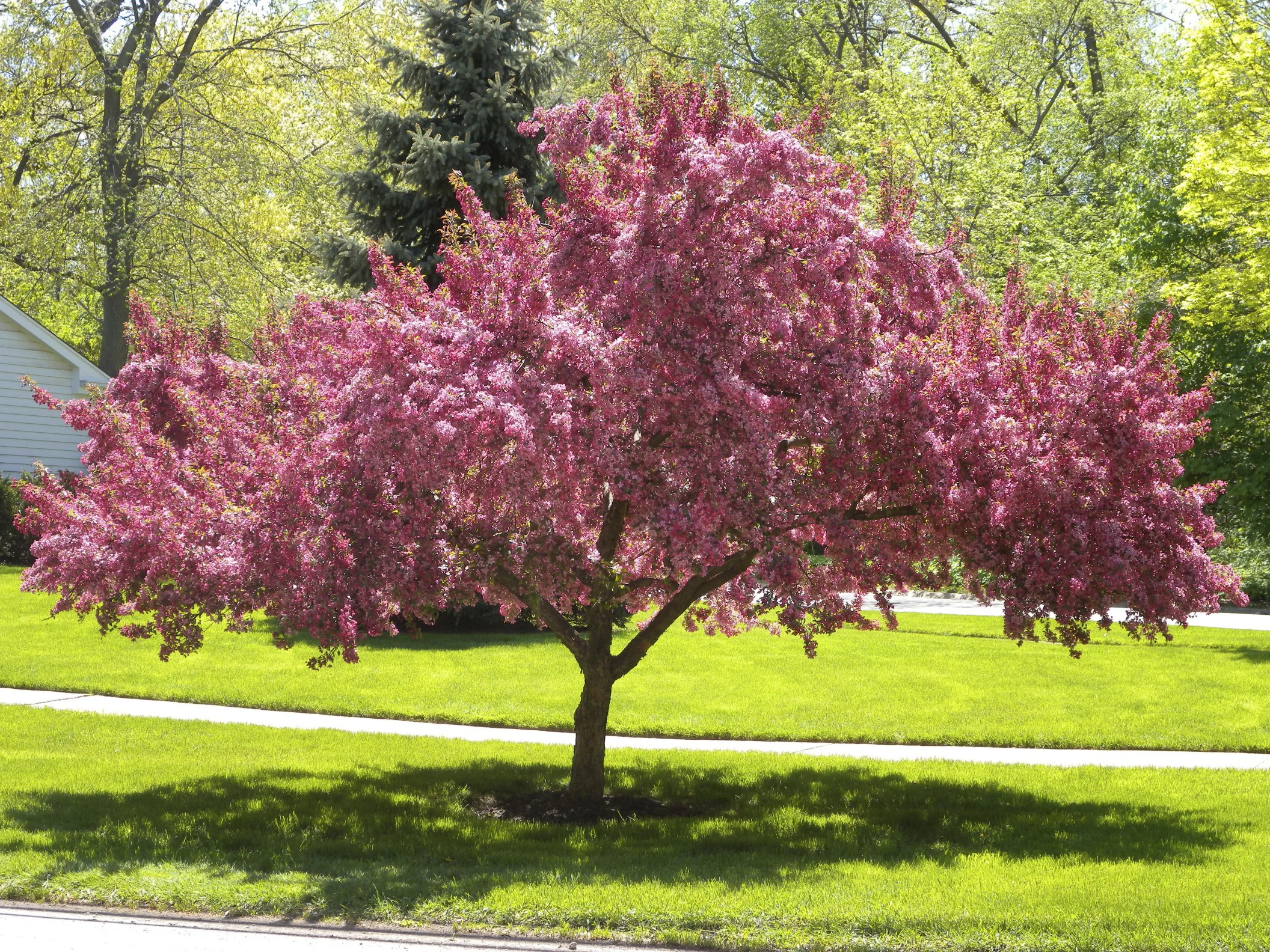
Crab trees are to the Chicago area what Southern Magnolias are to the State of Georgia, one of our most ubiquitous flowering trees. The amazing show of spring color that the Crab trees in the midwest display are among our most treasured garden treats. The Crabapple trees and all species of the rose family, of which they are a part, are the most cultivated tree species in the horticulturist’s palette. We have over 500 different varieties of Crab trees and that doesn’t even include all the Malus species that include the eating apples we have cultivated. But who can blame us, for the riotous spring explosion after our long hard winters and the long history of their use as food.
Tuliptree • Liriodendrum tulipifera
photos and text by: Lesley Bruce Smith
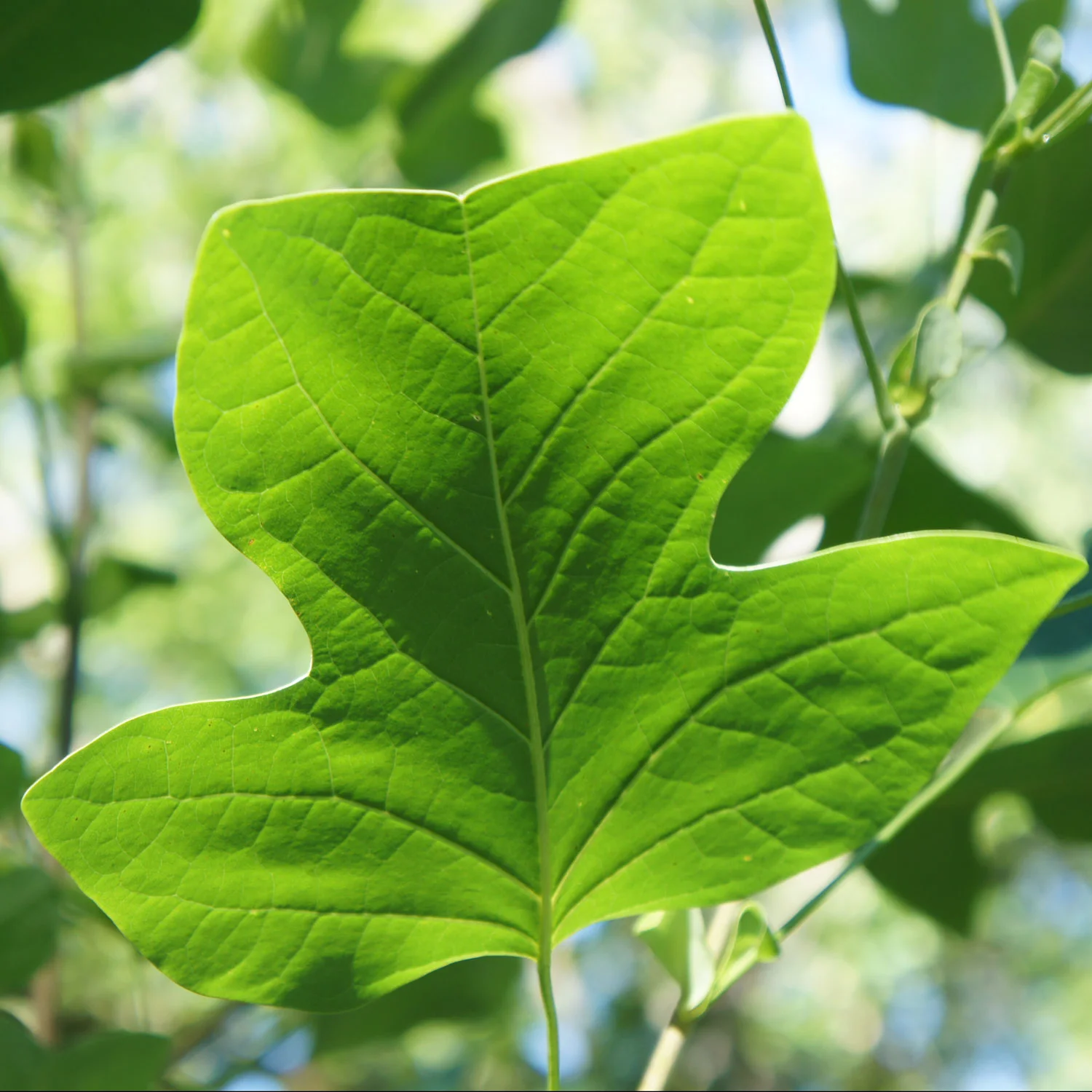
The Liriodendrum tulipifera was named by Linnaeus, the father of our binomial naming system, and it is a lovely name that means “lily tree bearing tulips”. It is a name that fits it perfectly. The Tuliptree is one of those trees that has many common names, Yellow Poplar, Tulip Poplar and was called Canoe Wood Tree by the native people of Eastern America where this tree originates. All these names point to some characteristic of the tree that was appreciated. The tulip references the beautiful pale yellow flowers that come out in our area in about June.
by: Lesley Bruce Smith, ISA Certified Arborist
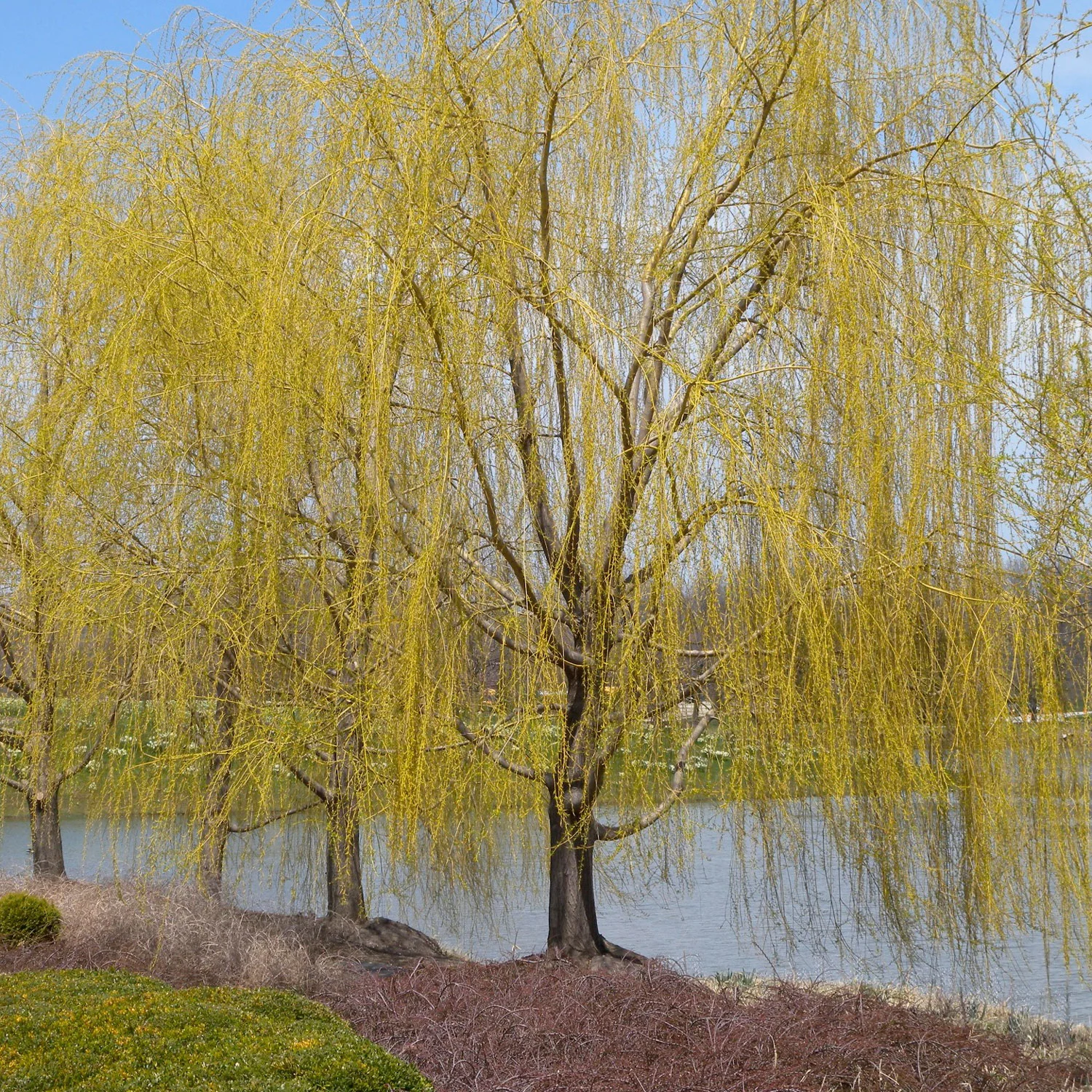
Weeping Willows are one of those tree species that have captured the imagination of artists down through the centuries. This is a tree native to China, yet Linnaeus named the Weeping Willow, Salix babylonica to honor the willows mentioned in the Bible. The Hebrews, exiled to Babylon: “wept when we remembered Zion (and) we hanged our harps upon the willow in the midst thereof”.
Red Oak, Quercus rubra
text and photos by:
Lesley Bruce Smith, ISA certified arborist
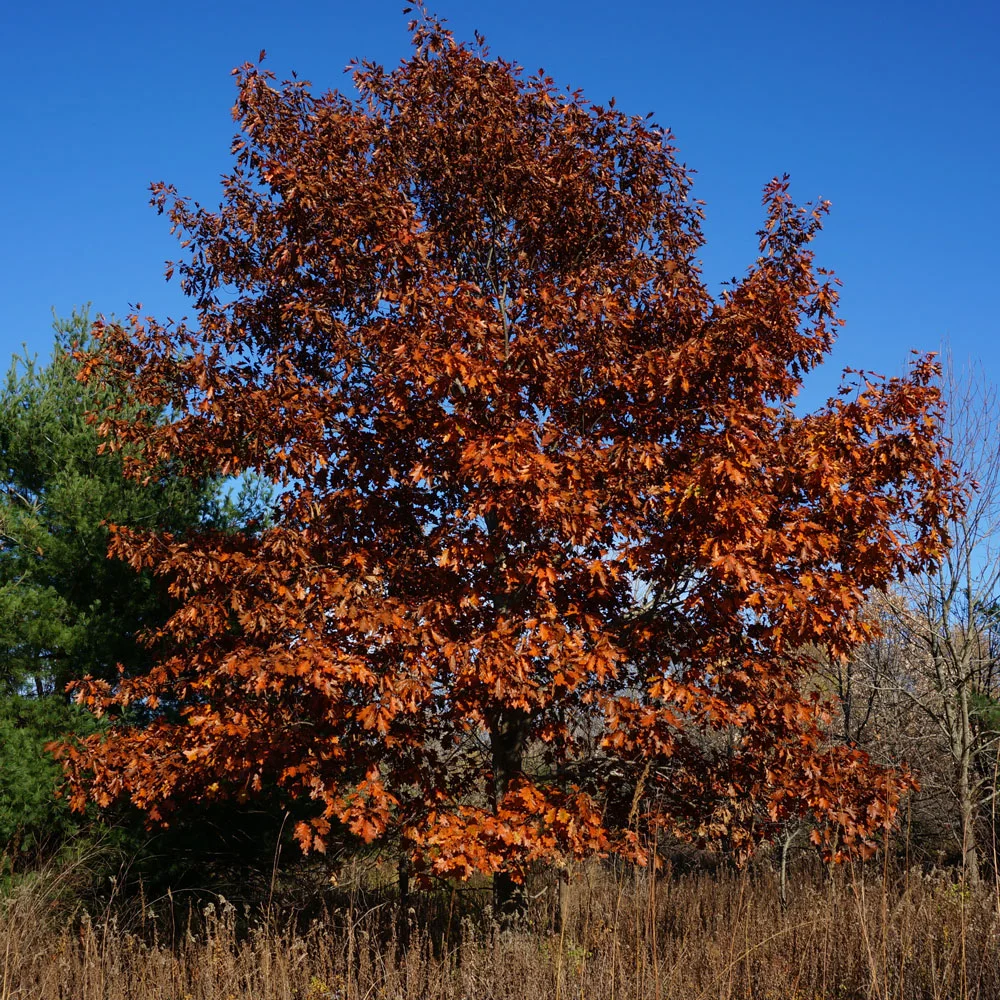
The Red Oak is one of our more common and beautiful native trees in the Oak family. Although susceptible to Oak wilt, a fungal pathogen that is potentially fatal, the Red Oak species are an important part of our urban forests. I love their fall color especially. Yet they have much to commend them all through the year. They have a long history of ethnobotany, the scientific study of the relationship between the use of plants by people. The Iroquois people had an interesting use of Red Oaks for healing ruptured navels. Callus bark or the rounded healing growth that appears when a tree is wounded would be scraped off the tree. This was then dried and powdered into a fine dust and then probably made into a paste and applied to the navel to assist in healing.

Live Oak
The Live Oak is so named because it is a tree that is native to the southern climates of the United States and is actually “evergreen”. We encountered this tree, up close and personal, for the first time, while on our bike ride through Louisiana this fall. Often graced with the softening effects of the spanish moss that hung from its branch tips and the ferns that would grow along its massive horizontal branches, it is without question a quintessential example of enduring arboreal beauty. While riding one day I stopped and photographed the tree shown here and paced off its size. It has a 125 foot branch spread and its trunk was 10 feet in diameter! It made me reflect on the fact that it was alive and probably quite large at the birth of our nation. A conservative estimate of its age would be between 350 and 450 years old and I felt quite humbled standing below its massive canopy.
The Live Oak was used for ship building and starting in 1799 large stands of southern land covered in Live Oak were purchased by the federal government for naval purposes. The Oak, it has been said, can be compared to our dog friends in its place as man’s companion. Throughout Europe and North America the Oak has a long history of deep religious and magical significance.
Tree of the month
Cucumbertree Magnolia • Magnolia acuminata
Gilbert A Smith, ISA Certified Master Arborist
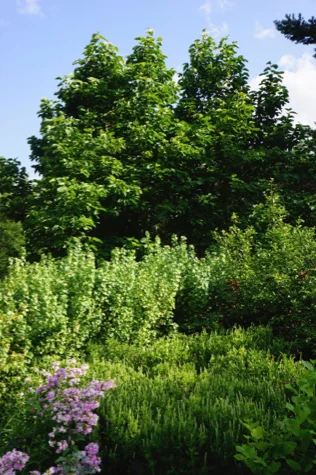
It’s a funny sounding name that doesn’t really capture this tree unless, of course, you’re just looking at the flowers and fruit, which must have been what the botanist that named it was looking at. The hardiest of all the Magnolias the flower isn’t showy, white or pink the way you’d expect. Flowers born on the upper parts of the tree, which grows 60 to 80 feet, you generally don’t know that you are looking at a magnolia at all. If you look real hard the fruit does look a little like a cucumber. I recommend it as a replacement for Ash trees and it’s among the best.
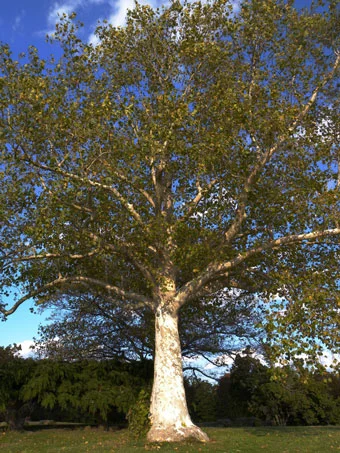
Tree of the Month
Sycamore • Platanus occidentalis
O the moonlight’s fair tonight along the Wabash From the fields there comes the breath of new mown hay Through the Sycamores the candle lights are gleaming On the banks of the Wabash, far away”
Maybe you recognize the state song of Indiana
The Sycamore tree is a standout, both because of its large size and it’s mottled white bark, that earns it the names of White Tree and Lacewood Tree. The bark of the Sycamore is too rigid to split or furrow as the tree expands (which is what most other trees do). Instead, “plates” of Sycamore bark break off and fall away revealing lovely, massive, white, mottled trunks.




Fire and Water, a story of climate on our trees...
or Drought, the Gift That Keeps on Giving
Mother Nature's Moment
by Lesley Bruce Smith ISA Certified Arborist
Backyard Wisdom

Backyard Wisdom - March/April 2022
by: Gilbert A Smith, ISA Board Certified Master Arborist
I’m sorry to say it, but we had to take this tree down for safety reasons. But, it has a story to tell us, from the inside out!
This Norway Maple landed as a “whirly bird” seed on a bluff overlooking Lake Michigan in Lake Forest in 1960. I counted the annual rings as best I could. I guess everyone knows how to count the tree rings to determine the age of a tree. In April 2019 in our Wisdom From The Trees article Lesley and I talked about how trees grow and how they heal. Also Aldo Leopold, in his famous book, The Sand County Almanac explained the history in the rings of a tree.

Backyard Wisdom - January/February 2022
by: Gilbert A Smith, ISA Board Certified Master Arborist
Driving through Deerfield a few months ago I stopped to take a picture of the above (left) pictured declining Norway Spruce. Almost every day we get asked, “What is killing my trees and what can you spray on them to save them?” When I drove up to these sick trees my thoughts were similar. Is this being caused by a disease or by a bug?

Backyard Wisdom - June/July 2021
by: Gilbert A Smith, ISA Board Certified Master Arborist
I got a call from a client this spring (2021) asking me to check her Beech tree this summer and spray any caterpillars that might kill it. This Beech is her favorite tree. I told her that I would do that and not to worry because caterpillars on Beech trees are normal, natural and healthy. She replied with enthusiasm, “Don’t tell me that! I don’t want my tree to die!”

Backyard Wisdom - May 2021
by: Gilbert A Smith, ISA Board Certified Master Arborist
This White Oak branch has been hanging in there for about 80 years so we can assume that it is pretty strong. Growing in Old School Forest Preserve in Lake County, IL, this tree is in its natural state, but what if it was growing in your landscape? Would you worry about this branch falling? Many homeowners worry, and for what seems like good reason; this branch is low, long and heavy. We wonder, how can it possibly not break? Because of that, in many landscapes, all of the beautiful low branches on our trees are cut off.

Backyard Wisdom - February | March 2021
by: Gilbert A Smith, ISA Board Certified Master Arborist
With snow on the landscape and temperatures in the cold range you're probably not thinking about trimming your deciduous (non-evergreen) shrubs. Still, now and until the leaves come back in May/June is a really great time to trim them. I’m going to give you easy to follow, step by step directions.
But first let me explain why.

“What is the matter with my Boxwood?” Lesley and I have been asked this question much too often in the last few years. Boxwood (Buxus sempervrens, microphylla, etc.) have many troubles, for example: Leaf Minors, Leaf Curlers, Spider Mites, Psyllid, Volutella and Phytophora fungal blights, Nematodes, too much water on overhead sprinklers, or too little water, winter damage, frozen soils, heavy soils, Boxwood Decline and most recently, Boxwood Blight. None of these by themselves are the cause of most of the Boxwood dieback. We can go through all kinds of soil and tissue samples, fertilizers, fungicide and insecticide sprays and still be missing the main cause.

Backyard Wisdom - December 2020
by: Gilbert A Smith, ISA Board Certified Master Arborist
Most of us have had a lot more time to be observing our own back yard this year. In your wanderings have you noticed little 1/2 inch mounds of soil often with pencil sized holes right in the center? What you’re looking at is the work of 250,000 native earth worms as they farm your back yard soil. What are they doing? They’re coming up to the surface, grabbing leaves, pulling them into their burrows and eating them.

Backyard Wisdom - November, 2020
by: Gilbert A Smith, ISA Board Certified Master Arborist
I didn't rake any leaves in my landscape this fall. I never rake leaves. That’s not because I have someone else do it, nor is it because I’m lazy, (though that point can be debated). It’s because leaf raking is a waste of my time and a waste of the fuel that powers our back yard ecosystem.

Backyard Wisdom - September 2020
by: Gilbert A Smith, ISA Board Certified Arborist
Forty-five years ago in Agronomy class I wondered what was so important about soil structure? Those of us in the plant world know that soil is made up of various ratios of sand, silt, clay and organic matter. We can test it for plant essential minerals like, nitrogen, phosphorus, potassium, etc. But what exactly is soil structure and why is it so important?

Summer 2020 - Backyard Wisdom
by Gilbert A Smith, ISA Board Certified Master Arborist
Right now, in our forest preserves and our landscapes we see the evidence of too much water causing our trees to die from drought. Let me explain. Trees, like every organism, need to breathe. Of course, we all know that during the day tree leaves use CO2 and give off O2, through the miracle of photosynthesis. What we may not realize is that trees, like us, respire all the time using O2 and giving off CO2. They don't have mouth parts, but they do have openings called stomates in their leaves, lenticels and ray cells in their stems and roots through which they ”breathe”.

by: Board Certified Master Arborist, Gilbert A Smith
Backyard Wisdom - April/May 2020
Fifty years ago when I was a young “tree skinner” Yes, that’s what they called us and with good reason. I was taught to paint all of the cuts that I made with tree tar. That was the measure of a good job. My father would say, “I saw a lot of ‘white eyes’ in the trees you trimmed today.” What an insult! “White eyes” were the newly exposed round tree cuts that looked like eyes on the branches.

by: Gilbert A Smith, ISA Board Certified Master Arborist
Wisdom From the Trees - February/March 2020 - Backyard Wisdom
So why does all this dirty talk matter?
Everyone who loves the natural world is concerned with global warming and its unpredictable effect on our’s and our children's lives. But it often seems as if it is out of our hands as individuals. It turns out, however, that carbon is the currency of the underworld, even in our own backyard. Let me explain.

by: Gilbert A Smith, ISA Board Certified Master Arborist
Backyard Wisdom - January 2020
How do roots grow through the soil? How do they know where the life essential water and minerals are located and how do they “eat and drink” them? In January 2019 I wrote in Wisdom from the TreesTM about the leaves’ long journey into the soil. Today, I want to take you further on that journey into the underground world of tree roots.

Backyard Wisdom - November 2019
by: Gilbert A Smith, ISA Board Certified Master Arborist
Everyone knows that deciduous trees go dormant and shed their leaves so that they don't freeze in the cold winter. So why don't evergreens shed their needles too? Actually, they do loose their older needles continuously throughout the year, as the older needles are shaded out by younger ones. This may happen most heavily in the fall, as is demonstrated every autumn, by our clients who begin to call, worrying about brown needles on their evergreens. The good news is, they never lose all of their needles, unless they’re dead. Evergreens are green throughout the year, but they don’t have the same needles forever!

by: Gilbert A Smith, ISA BC Master Arborist
Backyard Wisdom September 2019
Years down the road from the time your landscape was originally planted, Arborsmith Ltd. is called in to diagnose tree problems. Why is my River Birch doing so poorly when my neighbor’s is healthy? It is hard to answer that question without going back to the original construction. Most of our tree problems begin and end with the soil. We can’t see under the ground. We can test the soil and sample the leaves but all we have to do is move 10 feet away and the soil conditions change. Let me tell you the story of a typical suburban soil and how it affects tree health.

Backyard Wisdom July/August 2019
by: Gilbert A Smith, ISA BC Master Arborist
Every spring/summer I have to clean out my gutters after my River Birch drops its seeds and twigs. The funny thing is that you can see all of the germinated seeds, thousands of them but only in the gutter. Search the ground throughout my yard and you won’t find any young Birch seedlings. So what are these smart seeds teaching us?

Backyard Wisdom - June 2019
by: Gilbert A Smith, Master Arborist
What can I spray to get rid of moss in my lawn, or on my tree trunks or my roof shingles and what is causing it to grow so much? Although you can find moss herbicides, I do not recommend it!
It’ s a mistake to think that moss is an alien invader which competes with and ruins trees, roofs, or grass. There is nothing further from the truth. Mosses have been around on our planet for 400 million years, in fact they are the oldest living plants on land, and they've learned to survive and adapt to conditions where other plants cannot grow.

Backyard Wisdom, April 2019
by: Gilbert A Smith, ISA Certified Master Arborist
They don’t, at least not the way we think of healing. Damaged tissue in our bodies is replaced by new healthy tissue. Once a tree is damaged, however, it remains damaged for the rest of its life. This is because trees don't grow like people. Maybe a better comparison would be that trees grow like coral, annually adding new living layers on top of old mostly dead structure. We can count these new layers or annual rings to tell us just how many years the tree has been alive. Because of this “layered” growth pattern, no matter how tall a tree grows, the height of each individual branch on the trunk never changes.

Wisdom from the Trees, January 2019, Backyard Wisdom
by: Gilbert A Smith, ISA BC Master Arborist and Lesley Bruce Smith, ISA Certified Arborist
I fondly remember the autumn smell of burning leaves when I was a kid in the 1950s. Our push mower wouldn't grind them up so my brothers and I had to rake all those leaves out to the street and burn them. In the 70’s the environmental movement stopped the burning and it became the responsibility of the villages and cities to haul the leaves away. This month I’ll tell you the story of leaves from the tree’s point of view. It may change the way you perceive this annual ritual of fall.

Backyard Wisdom - March/ April 2018
by: Gilbert A Smith, ISA Board Certified Master Arborist
photo credits: Gilbert A Smith and Lesley Bruce Smith
Give your trees a breath of fresh air? Normally we think the other way around, that trees give us a breath of fresh air, and they do. Without trees we would soon choke on our Carbon Dioxide (CO2) and die from lack of Oxygen (O2). Thank you trees! But did you know that tree roots breathe just like we do, “in with the O2 and out with the CO2”? Now you can amaze your friends with this myth busting fact. Try it out on your most knowledgable gardening friends. You'll be surprised by how few people, even landscapers, know this.

Backyard Wisdom
by: Gilbert A Smith, ISA Board Certified Master Arborist
I’m speaking with a 60 year old Black Locust, Robinia pseudoacacia, who grows in the village parkway in Wilmette, Illinois.
Gil: Mr Black Locust I couldn’t help but notice the beautiful flutes and ridges in your bark. I had to stop and talk. Why is your bark so different from other trees, like the smooth bark of a Beech for instance or the white bark of a Birch?
Mr. Black Locust: Well let me first clear up one misconception you have concerning me.

Backyard Wisdom, October/November 2017
by: Gilbert A Smith, ISA Board Certified Master Arborist
Sixty years ago when I was a young sprout, my mother taught me to remove all of the little shoots that came up around the base of our French Hybrid Lilac so it would flower well. The lesson from her was that suckers “sucked” the “juice” out of the Lilac. Many old fashioned landscapers still do this.
When I was being trained as an arborist fifty years ago I was taught to remove all the suckers from the root crown, trunk and branches of the trees because I was taught it is healthier for the tree and that it looked better.

Backyard Wisdom - September 2017
Gilbert A Smith, ISA Board Certified Master Arborist
Can you see the red color of the spring foliage on this Burr Oak? It looks like fall color and in fact this is the same dynamic that goes on every fall. The color is a pigment called anthocyanin, which is responsible for red and purple fall color. But what is it doing in the young spring leaf tissue? Red Anthocyanins are one of the 3 plant pigments.Carotenoids providing orange colors like carrots and chlorophyll, which we all know, is green. These three pigments are present in leaves all the time but the green from chlorophyll usually dominates.

It sounds medieval, or at least Harry Potteresque, I know, but take a look at the picture and you will agree, witches brooming is rightly named. Now, as you drive the expressways in the large northern cities you will begin to have the affliction that Lesley and I refer to as “the arborist’s eye”. Be careful! Don’t take your eyes off the road, but you can begin to notice Witches Broom everywhere near heavy automobile traffic, especially in the winter when the leaves are notcovering up the ends of branches.

Wildflower Alert - An invitation to join the party!
SEE ILLINOIS’ BEST FLOWER SHOW FOR FREE RIGHT NOW!
Gilbert and Lesley will be at Daniel Wright Forest Preserve on Saturday May 6TH at 3:00PM next to the parking lot to lead a one hour wildflower walk. Bring your friends and join us for the wild dance.

BackYard Wisdom
by ISA Master Arborist, Gilbert A Smith
This month we had strong winds that blew several large evergreen trees down, like Fir, Douglas fir, and Spruce. Why did these trees stand for many years and then suddenly blow over? Our clients asked, “Why can’t the roots hold them up?” The answer is this: it is not a problem with the roots, it is a problem with the soil.

October 2016, Backyard Wisdom
by: Gilbert A Smith, ISA Certified Master Arborist
For a few weeks in the early fall you may have noticed some trees partly or fully turning color ahead of their sisters in the same species. This is a trees’ way of communicating. Do you know what its saying?
“I am under extreme stress here! I’ve got to let my leaves go, even though they feed me because I can not support them any longer
September 2016 Tree of the Month and Backyard Wisdom (combined)
Willow name
by: Gilbert A Smith, ISA certified Master Arborist
Mrs. Willow lives in the Chicago Botanic Gardens, dipping her roots into the waters of the Great Basin.
Backyard Wisdom • May 2016
by Gilbert A. Smith, ISA Master Arborist
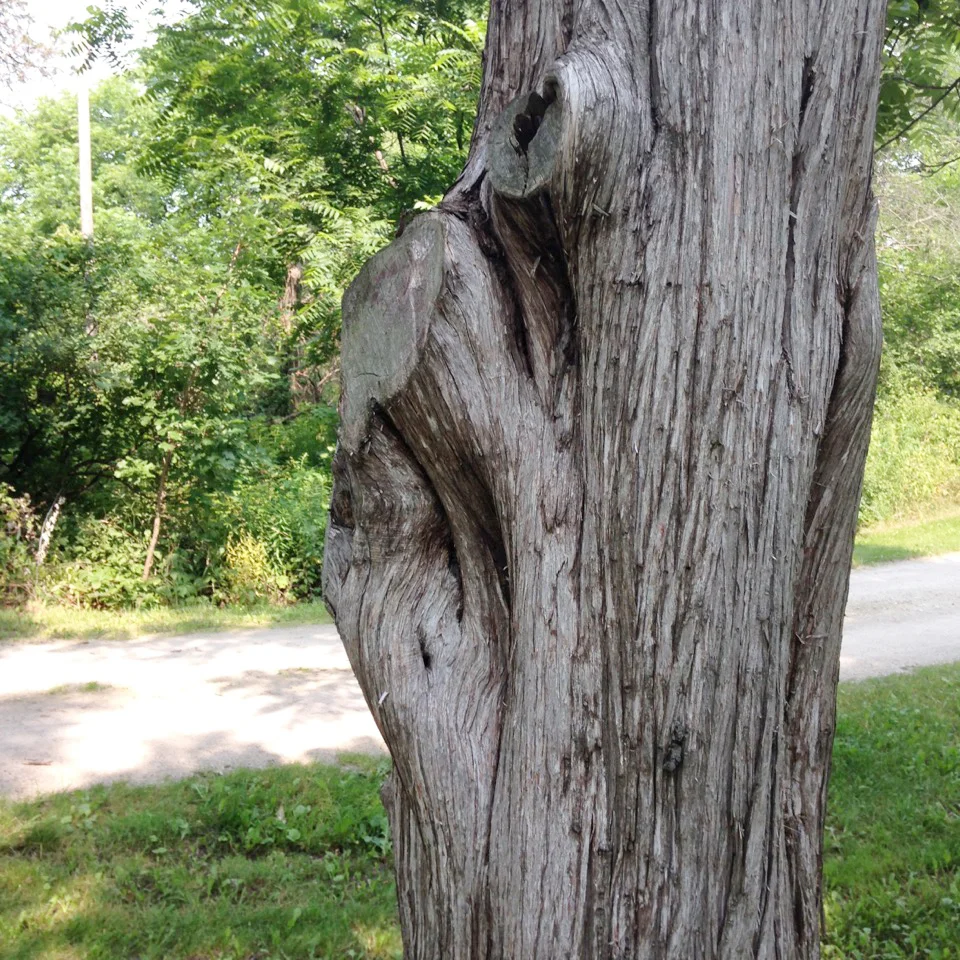
Gil: Mr. Redcedar lives near Daniel Wright Forest Preserve looking out over Milwaukee Avenue. I bet you’ve seen a lot of growth and change in your lifetime Mr. Redcedar.
Red: It wasn’t so long ago that all around Milwaukee Road the prairie was plowed into farm fields. Yes, I’ve seen changes, but I thrive on change. Like your ancestors, I’m a pioneer. That means that when there’s a disturbance, like a road being built, I jump in and grow where other trees can’t.

Backyard Wisdom • April 2016
by Gilbert A. Smith, ISA Master Arborist
This month I’m privileged to speak with Mr. Oak, who lives in a ravine along Sheridan Road in Highland Park, IL.
Gil: It’s nice to see you again Mr. Oak. Thank you for talking with us.
Mr Oak: Well I’m glad to. I watch the cars and people go by, always in a hurry and I wish they would stop and say Hi i to me. I have a lot of things I could teach them not the least of which is to slow down and enjoy my shade once in a while.
Mother Natures Moment

Mother Nature’s Moment - March/April 2022
by: Lesley Bruce Smith, ISA Certified Arborist
This week, like many times in the spring of the year, I was asked to visit a client property to examine some large Arborvitae to see why they were not doing well. The client thought that she needed a price for fertilizing these “stressed trees”.
It has been a rainy week after many months of drought in the Chicago area. As I stepped into the back yard I noticed I was stepping onto completely sodden soil. My shoes were making sucking noises while walking the length of the lawn to the back property line where the big Arborvitae were planted. It was easy to see from a distance that the area around the trees was about an inch or two under water. I managed to get under the trees and check out the soil with my soil probe. No surprise that the heavily clay like soil was totally saturated to about a foot below the surface.

Mother Nature’s Moment - January/February 2022
by: Lesley Bruce Smith, ISA Certified Arborist
It has been a while since we have published our newsletter and I thought since we have undergone some staff changes it would be a good time to make some introductions.

Mother Nature’s Moment - July 2021
by: Lesley Bruce Smith, ISA Certified Arborist
It has been a “good” year for funky leaf galls, or a bad year, I guess, depending on how you look at it. Galls are “abnormal vegetable growths caused by various agents, such as, insects, nematodes, fungi, bacteria, viruses, chemicals and or mechanical injury”. When our clients ask about these funny bumps on their tree leaves, I usually stop at the short explanation that they are completely harmless to the tree and normally caused by beneficial insects that lay their eggs in the leaf tissue which causes the strange growth they are seeing.

Mother Nature’s Moment - May 2021
by: Lesley Bruce Smith, ISA Certified Arborist
These last two years we have all learned about our deep needs as humans to be together. We were not meant to live in isolation, to spend long hours, days, months with very little meaningful interaction with others. Going about our days behind masks, unable to even read the cues that all of us take for granted in our unspoken communications with one another. We have been diminished by all of this and knowingly or unknowingly are in grief around all we have lost.

Mother Nature’s Moment - February | March 2021
by: Lesley Bruce Smith, ISA Certified Arborist
Almost every month we come to you with new information about trees. This month, and on and off in the months to come, I am going to try to introduce you to some of our good friends in the tree family.
The best way to learn the names of trees is to “get to know them”. The same way you get to know a new friend. First you learn their names, then you can remember their name when you see them and recognize their face and hair and the color of their eyes. Then, as you get to know them really well, you can tell what they look like from a long distance away, because of the way they walk or talk or have unique expressions or characteristics. It all becomes very familiar to you. You even learn to recognize them no matter what they are wearing or if they have had a hair cut. You KNOW them!

Mother Nature’s Moment - January 2021
by: Lesley Bruce Smith, ISA Certified Arborist
A decade ago when we were first visiting our daughter’s-in-law family home in the mountains of Austria we had the privilege of witnessing life on a European farm first hand. While there we watched her young cousins on the mountain alm1 playing, half naked in the pond where the pigs were bathing too. It was one of the first of many real life lessons, since, on the value of biodiversity, and the role of microbes in developing our human immune systems.

Mother Nature’s Moment - December 2020
by: Lesley Bruce Smith, ISA Certified Arborist
Thirty years ago when our sons were in grade school they had a classmate that had to flee, with his mom, out west to a place above tree line in order to not suffer horrendous neurological symptoms due to the abundant use of toxic herbicides and pesticides in our suburban landscapes. This was not a very sustainable situation.

Mother Nature’s Moment - November 2020
by: Lesley Bruce Smith, ISA Certified Arborist
This time of year the question of “How can we tell what is alive or dead?” is a frequent one. It is so second nature to us that we often forget to explain to you how we tell if a branch is alive or dead in the middle of the “dormant” season. Let’s start by talking about what we mean when we say: “dormant season”. In the ‘olden days’, our understanding of what deciduous trees were doing in the winter was intuitive but inaccurate. Trees that lose their leaves in the autumn, do slow down their processes in order to survive the long journey around the sun. However, to say that trees go dormant during the winter is a bit misleading.

Mother Nature’s Moment - September 2020
by: Lesley Bruce Smith, ISA Certified Arborist
Dr Alex Shigo, the father of modern arboriculture, once said: “Trimming your trees is one of the best things you can do for them, if you do it properly, and one of the worst things you can do, if you do it improperly.”
For a multitude of reasons we are seeing a huge number of trees that have been over trimmed or trimmed improperly. So what does that mean or what does it look like?

Summer 2020 Mother Nature’s Moment
by: Lesley Bruce Smith, ISA Certified Arborist
It seems very counter intuitive that browning and dead leaves could be caused by too much water, but I wish I knew how many times in the last several weeks I have had to say to clients…”This is a problem that has been caused, or made worse, by cool, very wet spring weather.”

by: ISA Certified Arborist, Lesley Bruce Smith
Mother Nature’s Moment - April/May 2020
This last winter when attending the iLandscape conference we listened to a seminar entitled Healthy Hedges. It essentially was teaching how to eradicate weedy species from established hedges in the landscape. This is not a new subject to us so I was surprised at the insights I gained. I have never been accused of being a fan of European Buckthorn, ever. I have always said the only good Buckthorn is a dead Buckthorn.

by: Lesley Bruce Smith, ISA Certified Arborist, Cancer Survivor
Wisdom from the Trees - February/March 2020 - Mother Nature’s Moment
These are indeed strange times. We feel it is vitally important to keep on the “sunny side” if you will, as we face down uncertainty. With that top of mind we are reminded that our lives, our health and our safety depends in large measure on our continued care for ourselves and the planet we live on.

by: Lesley Bruce Smith, ISA Certified Arborist
Mother Nature’s Moment - January 2020
In these colder, dark shorter days of winter I am reminded that we are indeed “beings of light”. This is a phrase that is tossed about somewhat lightly in our culture. As a horticulturist whose job it is to save trees, let me shed a little light on light (no pardon for all the redundancy).

Mother Nature’s Moment - November 2019
by: Lesley Bruce Smith, ISA Certified Arborist
The vast majority of our tree friends in the northern hemisphere do a great job of preparing for their winter journey. They don’t leave home, so their journey through time demands careful preparation for the freezing cold and weighty snows they will encounter during the winter. This year, those freezing temperatures arrived faster than normal. However, the native Illinois trees, early snows or not, go through the same cell hardening as during a balmy autumn. Thanks to a plant pigment called phytochrome, the cells that need to “harden” take their cues from the always faithful shortening of days, not our uncertain temperatures.

by: Lesley Bruce Smith, ISA Certified Arborist
Mother Natures Moment, September 2019
When choosing someone to trim your mature woody plants, a.k.a. trees and shrubs, it is important to have a few questions top of mind.
Should you pick the big franchise company, your landscaper or the guy or gal you saw down the street with the truck and chainsaw?
The very first thing you should insist on is hiring an ISA (International Society of Arboriculture) Certified Arborist.

Mother Nature’s Moment • July/August 2019
by: Lesley Bruce Smith, ISA Certified Arborist
It is difficult for us to remember that less than four weeks ago the temperatures were consistently in the 60’s and rainy, and we were wearing coats and rain gear almost everyday. We are all happy for the more summer like weather, however, the trees view it a bit differently.

Mother Nature’s Moment - June 2019
by: Lesley Bruce Smith
This year Boxwoods, Japanese Maples and honeybees all have something in common. They were all very badly affected by the vicious “polar vortex” freezing temperatures we experienced over the winter. Gilbert and I and our crews have seen more winter kill this spring than we have ever seen before, and for Gil that means in the last 50 years of trimming and caring for trees. It is a sad thing for us and for many of our clients who have lost favorite Redbuds or Japanese Maples or long time hedges of Boxwood. If it is any consolation just know that about 30-40% of the Japanese Maples in our practice were lost through this last winter.
Mother Nature’s Moment, April 2019
by: Lesley Bruce Smith, ISA Certified Arborist
This last quarter we have taught several workshops that focus on tree trimming. Whenever we have a chance to get in front of people to talk about trees, we don’t miss the opportunity to talk about tree physiology. Now before you click to the next thing with a big yawn, give me a moment to share with you just how exciting this subject can be. Understanding tree physiology helps those of us that live and work with trees to know how to help them live the longest and healthiest lives possible. As an arborist of almost 40 years I can tell you that some of the most damaging practices done to and around trees are done because of the many misconceptions we have about them. Understanding a bit about how trees live and grow helps us to be good tree friends.

Mother Nature’s Moment August 2018
by: Lesley Bruce Smith, ISA Certified Arborist
This year has been a tough one for the Blue Spruce (Picea pungens ‘Glauca’). More accurately, this year appears to have been a tough one for Blue Spruce because we have been called into a lot of situations to evaluate Blue Spruces that are in terrible shape. The problems that they are exhibiting now began at a minimum of 15-18 months ago.

Mother Nature’s Moment August 2018
by: Lesley Bruce Smith, ISA Certified Arborist
Over the last week or so we have received a number of calls and have noticed with our own Riverbirch that there are a lot of yellow leaves on the ground. This spring we had an unprecedented spring of cool temperatures and lots of rain, and then more rain. All that weather triggered the trees to produce an equally unprecedented number of leaves, or in tree language “food producing evapo-transpirators” which translated means that leaves not only produce food for the tree from the sun’s energy but they transpire water through the tiny holes they have called stomata.

Mother Nature’s Moment June/July 2018
by: Lesley Bruce Smith, ISA Certified Arborist
This time of year we find ourselves on a lot of properties that have young trees that are struggling or dead. As arborists we are the ones that get called in to diagnose, treat and in the sad cases do post mortem on trees that were installed less than two or three years ago and have just not survived. The reason we get called instead of the folks who installed the trees is because the infamous “guarantee” has expired along with the tree.

Mother Nature's Moment
© 2017, 2011 text and photos by Lesley Bruce Smith
This season finds many of us out in our gardens or in local forest preserves, with fall color not far away. Since we spend a good deal of time in your yards, as well, we know that there is a lot of poison ivy out there, even more with all the rain we have had. As professionals, we realize that the best way to avoid this often agonizing malady is to be able to identify and stay clear of the plant.

Mother Nature’s Moment May 2018
by: Lesley Bruce Smith, ISA Certified Arborist
The longer we work with trees the more amazed we are at their ability to communicate, not only with us, but with each other. This seems like a ludicrous idea to many, simply because trees’ ability to communicate is not like our own. They do not use words, yet as we learn more about the way they communicate, it is surprising and often astonishing. They are so much wiser than we think.
Mother Nature’s Moment, April 2018
by: Lesley Bruce Smith, ISA Certified Arborist
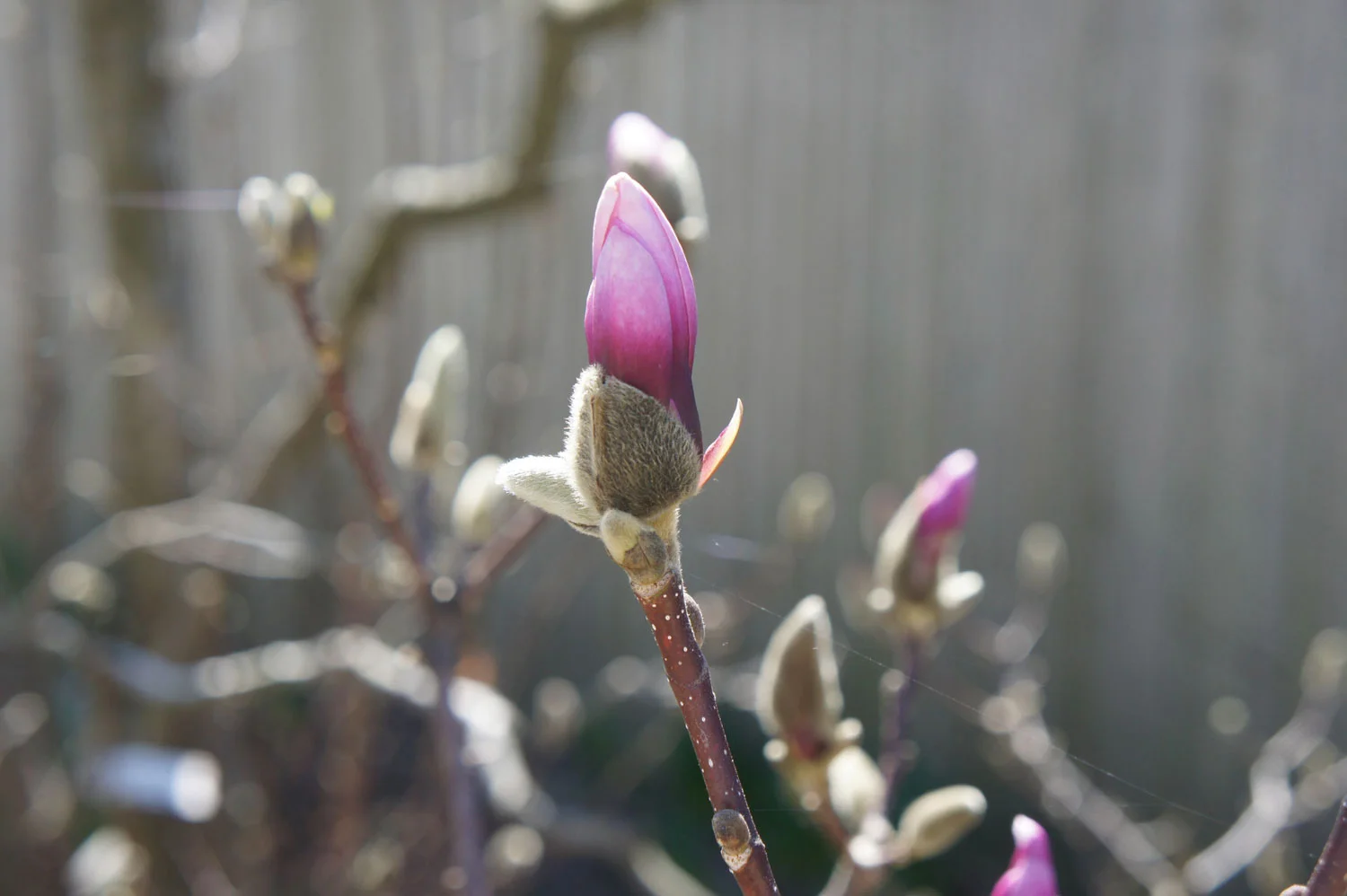
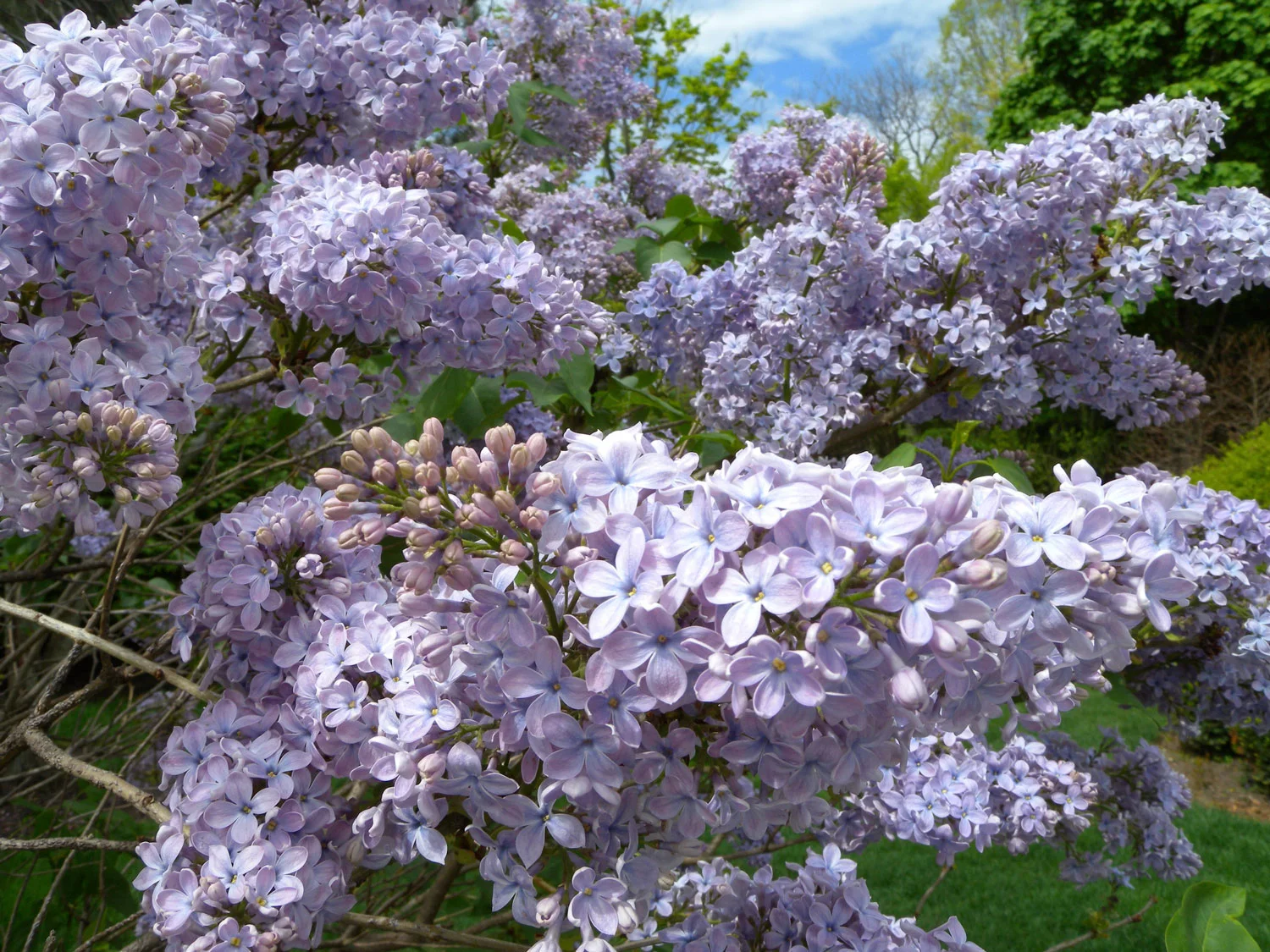
We all wait, not so patiently, for the warmer weather and spring time flowers. It is certainly one of our favorite times of year. The trees and shrubs are ready to explode, having worked very hard last summer, when the sunlight was at its zenith, creating all the buds that are full of sugars and about to burst out into flowers, leaves and eventually fruit. The key here is to remember that this year’s flowers and leaves were created last year, so if autumn or spring clean-up includes “shearing” the outside of the shrubs, most of the flowers will go away. A sad thing that we see repeated EVERY year.

Mother Nature’s Moment, October/November 2017
by: Lesley Bruce Smith, ISA Certified Arborist
This time of year we often receive calls from individuals requesting to have their trees fertilized. Fertilizing one’s trees seems like such a good thing to do for them, and yet there are so many misconceptions about tree fertilizer that, as arborists, we often are trying to bring clarity to this area of tree care.
The first thing we need to understand about fertilizer, or the first fact, is that it is NOT tree food. Trees make their own food from the energy of the sun!! This is actually science we learned in the second grade but many of us have forgotten it, or at least, have forgotten the ramifications of that fact.

Mother Nature’s Moment - July/August 2017
by: Lesley Bruce Smith, ISA Certified Arborist
A few weeks ago a friend of ours who lives outside our service area asked me about how to choose someone to trim his trees. His inquiry came in like this…
We’d actually like a filtered referral. A couple of years ago a friend at church hired a tree trimer and afterward felt that both he and his tree had been scalped. How do we decide if a big franchise or landscaping company will do any better or worse than a man with a rope and a chain saw? What questions should we ask?
Mother Nature’s Moment - July/August 2017
by: Lesley Bruce Smith, ISA Certified Arborist
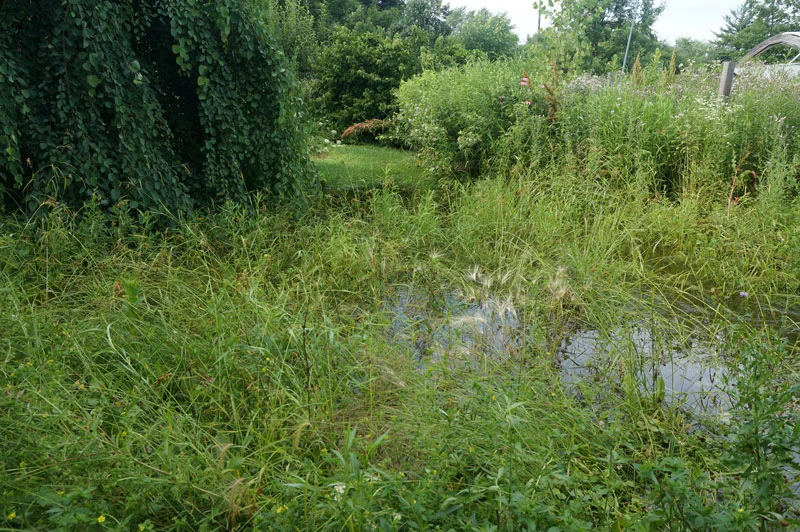
I don’t know if you have noticed, but we seem somewhat overwhelmed with how the rain and sun and rain, and rain and rain and sun have created huge amounts of growth on all our trees and shrubs, and all yours too! The trees and shrubs love mild (not too hot) moist conditions which trigger them to put out lots of green leaves=food producers=water evaporators.
Mother Nature’s Moment - May/June 2017
by: Lesley Bruce Smith, ISA Certified Arborist
Gilbert has discussed the phenomenon of Witches Brooming on trees. It is essentially one of the trees’ reactions to pollution. But he did not mention the fact that one of the amazing and now proven facts about trees and air pollution is that most deciduous trees have an amazing capacity for absorbing our pollution.

April 2017 - Mother Nature’s Moment
by: Lesley Bruce Smith, ISA Certified Arborist
As someone who has just spent the last 2 years having to be VERY intentional about recovering from both a severe bicycle accident and a breast cancer diagnosis it seems fitting that I would write about the benefits of trees on our health.
I’ve noticed a large number of people posting about Shinrin-yoku, or forest bathing, which became part of a national health program in Japan in 1982 and essentially just means being in the presence of trees.

Mother Nature’s Moment
by ISA Certified Arborist: Lesley Bruce Smith
As many of you know, I have just recently passed the one year mark of my breast cancer diagnosis. I am happy to report that although the work is as yet unfinished, all my one year scans are clean and clear. This is good news and worth celebrating. Yahoo!
At the beginning of this journey I just kept thinking I wanted to “get back to normal”.
